


This story contains explicit language and intense imagery.
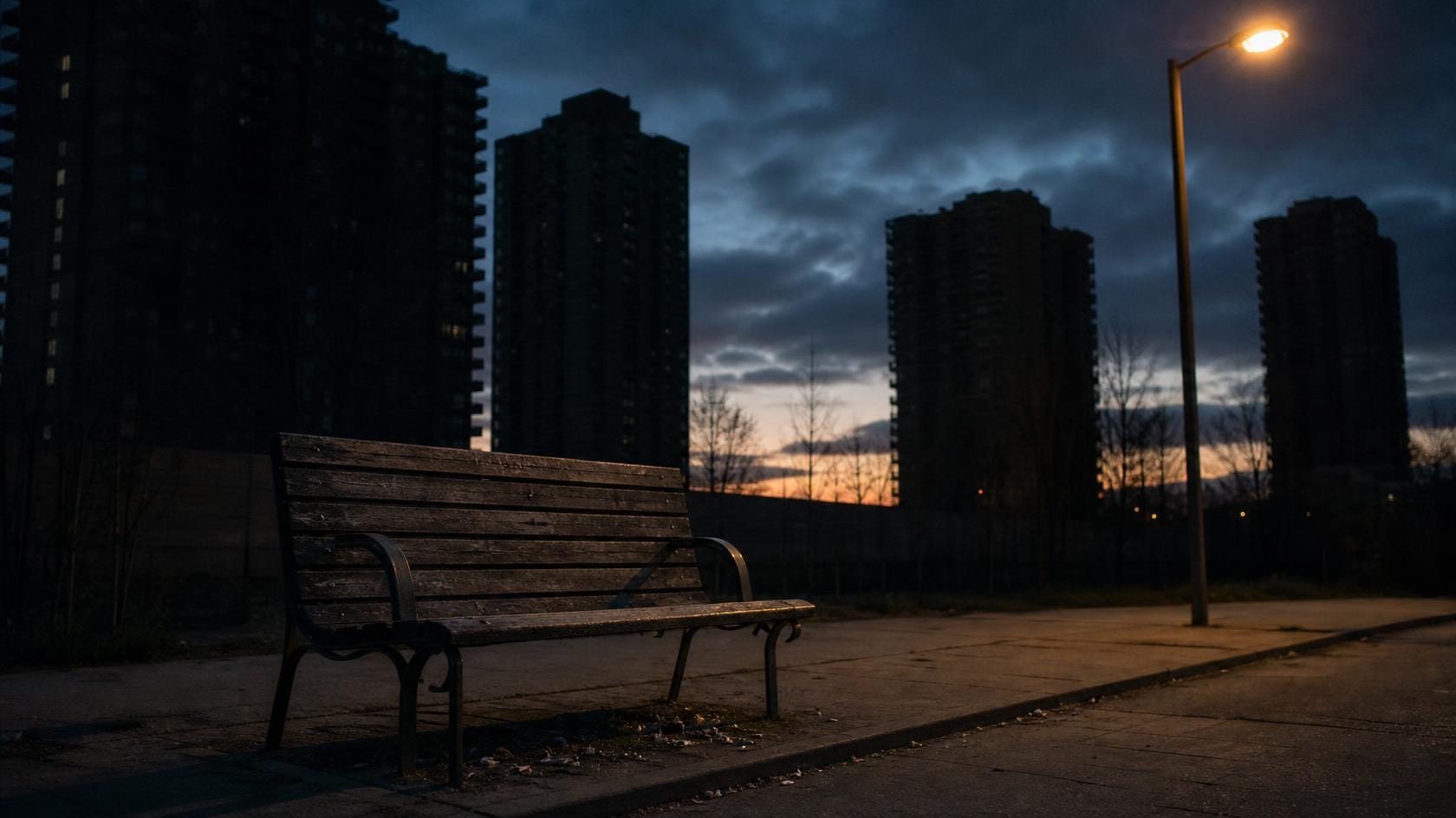
Cooley sits on the hard bench, rolling a street-made cigarette between dirty fingers. People walk by him, and he watches them not watch him. How their eyes dart away from the space they know he sits, making their choice. Not to see. To pretend he isn’t there. This is just one of his spots where he is content enough to be a ghost in the long shadows of the towers.
Fuck ‘em.
He strikes a match, pulls the flame up to his face, and takes a draw. The smoke punches the back of his throat, and he lets it catch there before breathing deeply, watching. Waiting.
Cooley has been waiting for five years. Five years and things just seem to stay the same. Or get worse.
“JESUS SAVES!”
Sometimes a lot worse.
“JESUS LOVES YOU GUYS!”
Cooley’s respite is broken by a street preacher whose loud calls echo across concrete and over everyone on their commute.
Praise the Lord, hallelujah.
Cooley takes another drag and flicks the smoke away and leaves his precious bench. Not how he wanted to start the morning, but that’s how it goes.
There are worse alarm clocks.
Yes. Yes, Cooley knows that’s true.
“JESUS SAVES!”
No one is listening.
Cooley is up on his legs and shoves off down the street.
Cooley knows that too. In his bones. No one is listening, just like no one sees Cooley.
Cooley does remember, though. Don’t let him make you think otherwise. He remembers his grandmother’s long kitchen counter, the smell of field peas and fat back wafting up from the avocado electric stove, her humming some gospel tune, and her thin frame swaying in the kitchen.
“And he walks with me, and he talks with me, and he tells me that I am his own…”
Cooley was little then. And hungry. He remembers reaching out over the paper-toweled plate covered with fresh fried cracklins. His small dark hand reached out and over the counter when his Grandmother’s voice cracked over him like a lightning bolt.
“You leave them there, Coldridge. Not until your momma gets here, you hear?”
“Yes ma’am,” Cooley remembers saying.
The world was warm then. The thin walls of his grandmother’s humble house felt like a fortress to him, whose ramparts were stitched together by his grandmother’s fierce and ever-burning love. It felt like nothing could ever be wrong with the world.
But that was before. And a long time ago. And the world did turn dark.
Cooley shuffles up North Tryon Street, up to the Main Library. It’s twenty minutes before nine o’clock, and he’s worried he’s already late. When he gets there, a small crowd of others have gathered.
“Morning, Cooley,” whispers Jake, who shuffles up behind him. “Got a smoke?”
Fuck, Cooley thinks.
Cooley hands Jake one of his street-made cigs, but stays quiet.
“You sleep okay last night?”
“It was hot,” Cooley grunts.
“Yeah, it was. So damn humid.”
Cooley keeps his face dead ahead. He doesn’t want to do this with Jake. Not this morning.
“Did you hear the news?” Jake continues, dragging Cooley into his orbit.
“What?”
“Boswell? Iraq?” Jake says.
The front doors open up, and Cooley pushes away from Jake as the gathered crowd shuffles in, grateful for the cool air conditioning. After making their way through the security kiosk, nearly half of them make their way up the fourth floor, screwing up the open-air staircase, where the neurolink pods are located. Cooley takes the steps two at a time, despite the heavy weight that hangs from his right ankle.
The security bots are stationed on every floor, each of them gazing down from their respective balconies like blank-faced vultures. Cooley acts natural. The bots are looking for weapons, for disorderly conduct. Not him. They don’t see him. After all, what choice does he have?
Rushing past four others, Cooley finds himself outside one of the neurolink pods and taps his library card outside the kiosk. The pod door clicks open, and Cooley walks inside.
“Welcome, Coldridge,” the automated voice says upon his entry.
Without a response, Cooley puts on the public neurolink headset, open ones that can interface without implants. As he does, the feed kicks on, and Cooley experiences the overwhelming sensation that he has been transported—no, flung—to another place. He finds himself standing in a white, pristine room, like a European salon.
He sighs, his face slackening.
A message on one of the white walls fades in. “This public service connection is funded by Amity Holdings Incorporated.”
The neurolink menu in the guise of a slim female appears, walking towards him in the salon, her high heels echoing off the marble floor.
“Good morning, Coldridge. How can I help you today?”
“Place a call to Andy Fairweather,” Cooley says, staring at this new smokeshow of an interface, and how he’d love to get a piece of that.
She ain’t real, you fool. Chill the fuck out.
This is the voice of Michael, his big brother. Big Mike. He does this. Takes up space in his mind rent-free. Sometimes, when Cooley gets high, he swears he can see Big Mike standing at the edge of his vision. His frame and broad shoulders standing like a shadow in the distance. Watching him. Seeing him.
He shudders and pushes the image away from his mind, choosing to stare unashamedly at this woman’s —not woman’s —breasts.
“One moment, Coldridge.” She blinks and repositions her frame as if to hide from his gaze.
Shit, they got these things working like the real thing, he thinks.
“He’s on the line, Coldridge, waiting for you. Patching him through. Is there anything else you needed today?”
“No,” he lingers, allowing his fantasy to play in his mind. “Not today.”
“Very well,” says the digital menu automation. Did her voice sound annoyed at him? Could she actually be…
“Coldridge Anderson?” A deep, authoritative voice cuts through, and he blinks. The woman is gone, and a desk has appeared in front of him, materializing out of nowhere, and behind it sits Andrew Fairweather. His goddamn parole officer.
“You were a few minutes late, Mr. Anderson.”
Cooley swallows, trying to realign himself for this mandated conversation. “I’m sorry, sir. I had to get a neurolink booth at the Main Library branch. I had to wait for it to open so I could make the call.”
The man behind the desk stares at him like a predator, his eyes looking for the slightest tell of deception.
Breathe, Cooley. Breathe.
“Okay. How have you been these last two weeks?”
“Staying clean. Trying to find a job,” he lies.
“You’re still at the shelter, correct?”
Cooley goes stiff.
The shelter. Where the rats dance in halls, and the burnouts rock like loose ceiling fans, and where the reek of urine and shit is all that greets you under the flickering fluorescents.
“Yeah, I’m still at the shelter.” Whatever it takes to get you to shut up, man, he thinks.
“So if I call them and check the logs, that’s what I’ll see?”
Cooley doubles down. “Yessir, that’s what you’ll see.” Your caseload is so thick there ain’t no way in hell you’re checking.
Again, Fairweather stares at him, and though Cooley knows it’s a neurolink connection, it’s as if the man could leap over this desk and grab him by the throat.
“Well, we need your sample today, Mr. Anderson. Middle of the month.”
A sharp pin prick pierces Cooley’s head where he put the neurolink headset without warning. Like a paper cut or a bee sting, the blade pierces and disinfects in a microsecond, reading Cooley’s unique chemistry.
Fairweather looks off, checking a screen that is not shown in the neurolink interface.
“Alright, Mr. Anderson. You’ve got a clean read this time. Good job. Your UBI will be sent to your account now.”
Cooley can barely hide the sneer that wants to dance on his face. Somehow he manages.
“Thank you, sir.”
“Check back in two weeks. Let’s say 9:15 am so you can get to the branch, okay?”
“Sounds good, sir. Thank you for your time.”
The feed snaps shut, and Cooley is sitting alone in the salon. The menu approaches him, this time taking the guise of an older African American male.
So much for that, he thinks.
“Is there anything else we can assist you with, Mr. Anderson?”
“No,” he says, frustrated by all of it. Such a goddamn waste of time.
The menu fades, and he checks his Union-issued ID watch and sees a visual chart rise, the meager balance of his credit jumping with the transfer from Fairweather.
Five hundred and fifty-five credits added to make a balance of six hundred and seventy-five.
That’ll do, Cooley thinks.
Cooley stays at the library until closing time, then walks up North Tryon with an itching in his skin. Cars buzz by him, sounding like quiet hovercrafts, as folks less fortunate shamble up and down the hard, broken sidewalk. The last of his rolled cigarettes burns in his mouth, dangling from his lips like a limp ember. His legs ache, and he is hungry and tired.
Cooley finds himself at the Sugar Creek intersection, the sun starting to descend when he turns left, heading to the haunts he knows he should not be going. The places the little box on his ankle is definitely going to ding him for. Yet he still marches.
Where you going, baby brother?
Cooley shoves on, ignoring Big Mike.
Big Mike is dead. Body in the grave. Along with everybody else.
Cooley’s hands begin to shake, and he takes one last draw from the butt of the cig and flicks it.
I need more than this shit. I need a drink, a bump, a whore. Anything.
Cooley looks down at his watch and sees the UBI credits banked and ready on the e-ink display. It will get him something. Anything. Anything but these ghosts and grief.
You’d do better to turn around, Cooley.
Cooley keeps on marching, just as the street lights flicker on and cast their pale white lights on the busy highway.
At the end of the street, just over the hill, down near the interstate exit, he can see them. The girls, the pimps, and the dealers congregating in the fast-food parking lots, the cheap motels, reveling to ply their trades with the oncoming darkness. He flies towards the scene, his eyes wide, thirsty and restless for whatever his six hundred credits can get him.
A sound echoes up in the darkness, and Cooley’s skin crawls.
He looks all around, as cars keep flying down Sugar Creek. Down the bank of an empty, scrub-filled lot. Cooley stares into the darkness.
The strange sound lifts up again, a call over the hum of traffic.
Was it a moan? Someone crying?
Cooley stares out and stops in his tracks. The blinding headlights break out and mirror back beams that reflect off the broken beer bottles and cans strewn over the abandoned land. The light of the glass looks like eyes to Cooley. It feels like something is watching him.
And then he sees it. A tarp. Or a moving blanket, heaped and discarded, lying in the ditch. Cooley feels the hair on the back of his neck stand up. He looks back up towards the interstate.
Why did I come this way? He wonders.
Whatever pull he felt from the thrill of whores and drugs is gone now, evaporated and squelched by something greater that moves in the darkness.
Shit.
Cooley is shaking, as the energy of the place shifts. The headlights of the oncoming traffic illuminate his dirty face as he stares into the darkness.
Second after second.
Light. Dark. Light. Dark.
And then he hears the moan, unmistakable.
He stands there, still as the traffic flows, hundreds of folks from miles around going about their business, choosing not to slow down. Choosing not to see the man who stands ramrod straight on the sidewalk, like he’s seen a ghost. This man who must be crazy, who stares out into an abandoned trash-heaped lot, as still as a statue.
Cooley knows only one thing. Whatever happens next, there is no going back.
Another low moan threads through the sounds of the traffic, and Cooley feels his body descend down the ditch and towards the dark shape. It is a dark blue plastic tarp, weathered and aged, and the ripening stench of body odor and blood collide against Cooley’s nose. Cooley sees his hand pull back the tarp, and there, lying within the heap, are the wounded and bruised remains of a broken body.
A girl.
Her head is matted with a dark streak of dried crimson, and Cooley can see her arms and legs are splayed out in unnatural angles. A single eye peeks behind a busted and bruised face, and it is full of terror. She opens her mouth to scream, but only a low gurgled cry eeks out.
Oh shit. Oh shit, oh shit, oh shit.
Cooley springs back from her and rubs his hands through his dirty beard.
What do I do? What do I do?
The terror-filled eye of the girl stares at him, and she moans, scared and frightened.
“I’m not going to hurt you. I’m not going to hurt you!” his voice rises, louder, more terrified as he repeats it.
Tears suddenly fill his eyes. He doesn’t know why. This girl is barely an adult. Alone and lying in a ditch. Forgotten.
In the chaos that must have lasted only seconds, Cooley feels someone else in the darkness with them, a flash of headlights streaking past like lightning.
No. Not someone. Two.
Big Mike. Cooley could never forget the shape and stance of his older brother, who used to stand beside him like a mountain on the horizon. Beside him is a small woman, rail thin, but unmistakable in the darkness, her eyes burning like the ends of cigarettes.
Her voice cracks over him like lightning, “What are you going to do, Coldridge?”
Cooley is running and bursts into the gas station like a maniac, his eyes wide and his voice stuttering. The digital gas attendant blinks from behind the counter but remains calm. Cooley realizes it’s the same woman interface as the menu from the neurolink he encountered in the library.
I don’t have time for this shit.
“I need you to call an ambulance,” he commands, staring the menu in the eyes.
“Okay, sir. It seems there is an emergency. What’s the trouble?” the doppelganger attendant states in a much too cool voice.
“I NEED YOU to CALL an AMBULANCE! There is a GIRL out there. Half dead. I NEED YOU to call them, NOW. In the vacant lot right…”
“I understand. I’ll place the call. What is your name, sir? You know I can’t place a call without identification and benefit coverage.”
Cooley flashes his watch up to the terminal, and his name and his account flash in the air, hovering. His funds, his full legal name, and everything else are on full display within the empty gas station.
The attendant goes silent for a few seconds, then she turns to him.
“The call has been placed, sir. That will be four hundred and fifty-seven credits.”
“Take it,” Cooley says, unable to get the terrible sight of the girl and the ghosts out of his mind.
He flashes his watch up to the kiosk, sees the UBI deduct, and the attendant smiles.
“Any additional hospital bills, of course, will be à la carte at the facility. Is there anything else I can do for you, sir?”
I got to get out of here.
“A pack of smokes. Please,” Cooley whispers. Another fifty credits disappear from Cooley’s account, and he walks outside, back into the darkness.
It takes five cigarettes before the ambulance pulls up to the abandoned lot. He squats by her and talks to her.
“I’ve called an ambulance. They are on their way to get you. Okay? You’re going to be okay. Okay?” Is he lying? He’s not sure.
“Okay,” she whispers, her voice nearly swallowed in the darkness.
He rides with the EMTs and the girl back to the hospital. He sees her there in the harsh fluorescent light.
“We’re almost to the hospital. Just try to hold on, okay?”
“Okay,” she says, her one good eye finding him. Tears stream down her face. “Thank you.”
Cooley doesn’t know what to say. There is nothing to say. He just tries to be calm and reassuring in her presence.
She’s in a bad way. Whatever happened to her…she…she might not, he thinks.
You did what you could, Mike whispers.
The ambulance pulls up to the emergency room, and he watches as they take the girl out of the truck on the gurney. He gives all that he has left from his account to pay for whatever the girl needs. It’s all he knows to do, and the worn-down, beleaguered hospital nurse takes his payment and stares at him in the bustling waiting room full of sick and injured people who flow through the place.
You can go, her face says.
So Cooley goes, back into the darkness outside the glow of that towering place. He walks up the sidewalk under the burning yellow street lights that hang above him, marching on, silent, for many miles. Somewhere in this ramble, he finds a bench and claims it. He sits there for a long time and smokes the rest of his cigarettes.
In the early morning, he watches the sky give up its darkness and begin to glow with the first signs of the oncoming dawn. First to a dull gray, and then to blue. He glances at his Union watch, his hands shaking. The screen catches the dawn, and reads 0.00.
Shit, man, you’re a mess.
And he knows it’s true.
He sits there, and the world begins to wake up again. The roads fill with traffic, and the sidewalks fill with people, augments, and bots. Cooley sits like a rock in the stream, letting all of it flow past him. At some point he falls asleep.
The sound of a rapping cracking over the pavement draws closer to Cooley as he rests uneasily on the bench. A white cane flicks against his leg, waking him up from his uncomfortable slumber, and the man connected to it stares in his direction, looking at him behind shaded eyes.
“I’m sorry. Didn’t mean to pop you.”
Cooley stares at the man. “It’s okay.” Cooley’s voice is hoarse. Tired.
“You doing okay, brother?” the blind man asks.
“I don’t know,” Cooley answers, unable to define how he actually feels.
The blind man stands there, and Cooley sees himself reflecting back in the man’s shades.
“Mind if I sit?” he says.
“Go ahead,” says Cooley.
“You sound like a man who’s seen a few things,” the man whispers, tapping on his cane.
Cooley rubs his face and feels the tired ache of the previous night waft over him.
“Man…you wouldn’t believe it if I told you.”
The blind man laughs, a low rumble, kind and strong. “My brother, you don’t have to tell me. I already know. I might not be able to see, but I do listen. That’s the problem nowadays. No one slows down to listen to one another anymore. This world keeps on doing its crazy dance, and all we have to do…” He pauses. “I mean get to do is hang on. You feel me?”
Cooley stares out over the city and can find no words.
“I feel you,” he finally says.
“What’s your name, son?” the man extends his hand out into the darkness.
Cooley grabs it. “Cooley, sir.”
The man holds it, strong and hard. “That ain’t your name, son. I asked, what is your name?”
Cooley looks at the man, who somehow looks back, despite it all.
“My name is Coldridge Anderson, sir,” he says.
“There it is. And there you are.”