


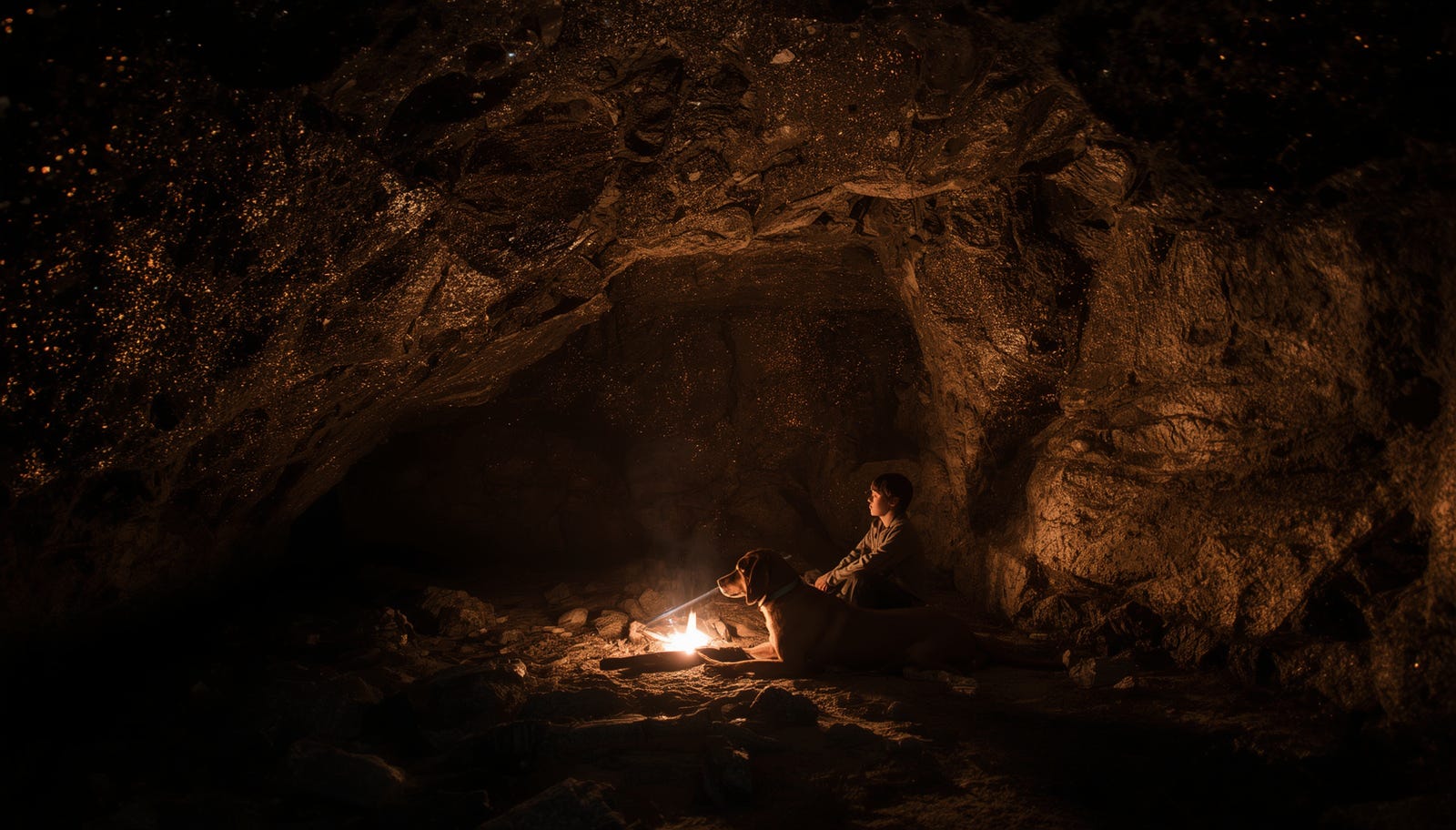
The barefoot boy sits, watching the dappled light dance upon the wild creek’s reflective surface, his senses attuned to everything around him. The sound of falling water rolling down the steep mountain. The rich smell of shaded rhododendron, its roots anchored down within the damp, wet earth. The cool air that slides through the thick canopy, blocking the heat from the sun that runs its circuit somewhere up above him.
If his parents could see him, they would be amazed at how his body had changed. Two years. But it was as if he were in a rush to grow, his limbs springing out from him with the rapid, impatient energy of early adolescence. No longer a boy, but rather a shadow of a man, his voice dropping down to a resonant pitch, and a frame knit with a lean strength that even he was unaware of.
But there is no one to see him. Not anymore.
He watches the water, straining to see behind the light dancing on the surface. Watching the crawfish crawl up towards the old sock he had found and baited with the remains of the squirrel he and the dog had caught. The offal of the rodent was priceless bait for crawdads, and he watches patiently for the smell of it to attract his dinner below the water. In less than ten minutes, the crawdads come up and out from the crevices of the creek, determined to get to the meal behind the sock, all while the boy carefully scoops them up one by one to throw them in a pot. It takes less than an hour to get the pot nearly halfway full, more than enough for a meal, but the boy is careful.
Leave some behind.
Quickly he fishes out five of the crawdads, younger ones, and plops them back into the creek. Then he hoists the dirty, wet sock and heads up and out of the water, satisfied.
The crevice cuts through the mountain at a strange angle, sliced through what must have been a rich vein of mica. The walls of the fissure are held up by the remains of some ancient hewn lumber, but the boy doesn’t worry. As he stokes the embers of a slumbering fire, the stone walls light up like starlight, the firelight reflecting off ten thousand pinpricks of mica still lining the abandoned mine. The second pot of water begins to boil, and the boy quickly adds his catch to it, killing the crawdads instantly.
The sound of rustling outside the cave causes the boy to stand up and grab the crowbar that hangs by him. Always by his side. He stands and waits, only to see the dog burst through the underbrush, her face happy and wide.
“Hey, girl!” he exclaims, bending down to embrace the dog. She licks his dirty face, and he can’t help but laugh. He turns to check the pot and, using a stick, fishes out a red-hot crawfish and flings it to the dog.
“You hungry, girl?”
The sound of the dog cracking down upon the crawdad’s shell is instantaneous, and they relish their small silent feast, he working hard to pull the white meat from behind the shells, and she crunching on each crawdad whole.
It had been two years. Two years since their farm fell to Amity. Two years had passed since his family had quietly and painstakingly dug their way through the earth of their root-cellar shelter like desperate rabbits, inching towards an unlikely escape. Weeks of him and his brother pawing at the red earth, their fingernails caked with dirt and blood in the light of flickering lantern light, the sound of erupting landmines exploding around them, threatening to cave in the very tunnels he and his brother had worked to dig. But their father had been there, working, always working, to painstakingly take apart the four wooden beds he had built in the shelter, and disassemble them in order to hoist and brace the walls of their tunnel. Their mother was the steady glue between the three, serving as a constant encourager to them all, even when the weeks dragged on, and the darkness of the hole felt like it would swallow them all.
Cade. Cade had struggled. He had watched his brother grow despondent in the closing darkness, as if the heavy earth was already collapsing over him. It came over him slowly but with a constancy that could not be stifled or held back. He knew it was because his brother needed the light from the sun. Without it, he was coming undone. Underground. In this tomb. He did what he could to distract Cade when they rested from their digging in the common area of the root cellar. Playing tic-tac-toe in the dirt, playing tug of war with Polly and Chance in the tunnel. Whatever he could do to keep his older brother from losing hope.
It wasn’t enough. Cade eventually spent full days lying on the clay earth floor of the main room, while Paul and his father kept working. Kept digging. Sandy tended to him, praying over him, singing, and reading Scripture to him in the dim light. He lay there for days on end.
“Pray for him, son,” was all Paul’s father said.
It was work that never let up, each inch of progress costing a gallon of sweat, made harder by the meager food. Rationed from the rows and rows of canned produce that their mother had spent years putting up, he watched as the years of preparation diminished quickly. Each jar emptied filled the worry and anxiety on his parents’ faces as he watched them make dreadful calculations that were not spoken. But they at least had food, and with it several barrels of water that had been wisely hauled below years before. Coupled with an underground latrine and vent, wisely dug out by his father during that same time, they were doing better than he would have ever guessed. His father’s preparedness astounded him, but even his father had limitations. No shovels or earth-moving instruments were to be found down here in this dark pit, so by hand they dug, painfully and slowly.
The next day, he and the dog hike up to the rock ridge, weaving their way up the steep, canopied mountain by switchback, moving as slowly and as quietly as they can manage. A low rolling cloud blankets over the mountaintop, thundering with a reluctant, tired energy. He glances up at the sky and tightens his thin shirt around him. His fingers fumble with his buttons, sliding the topmost through its hole, and the movement triggers a memory.
His father, kneeling down. Helping to button his shirt, rubbing his hand through his hair, whispering, “You almost had it. Just keep going.”
The memory of his blue eyes, his smell, the octave of his voice. They feel distant now. Hard to remember, but still they line his eyes with moisture, these thoughts. He coughs, doing what he can to keep going, to keep marching up towards the top. The thunder rolls above him, and he moves, his mind heavy with grief.
A clattering, squealing call cuts through the forest, and he seizes for just a second before grabbing the dog and hitting the ground. He waits, holding her near his chest, the hound whimpering.
“Shhh, girl. Shhh.”
Slowly, he rotates his face up and towards the canopy. Between the branches and the gray sky, a flying object soars over him, and he spies it through the trees. Giant and white, its wingspan stretching out to enormous proportions. At first, he swears the thing is a duck, but there has never been a duck this big. The thing screeches as it soars through the canopy, but its large wing clips a pine tree, and it careens to the ground with a thunderous crash. The dog pulls against his arms, but he ratchets down on her hard, refusing to let her go until she whimpers.
He waits, his eyes locked on the spot where the beast fell. Counting his breath.
When the forest regains its silence, and the buzz of bugs and the songs of birds return, he slowly releases his grip from the dog and snaps, commanding her to stay where she stands. She stands alert with manic frustration, but obeys. He makes his way over to this fallen thing, this out-of-place angel.
It lies there in a heap, wings twisted and broken in unnatural configurations, a victim of its own speed and its own weight. The boy’s mouth salivates, his body longing to feast on the meat of this giant, but he hesitates. Something is not right about this.
Too good. Too good to be true.
He stands over this thing that looks like a bird, but he knows it is not, trying to make sense of it, this man-sized bird that lies collapsed below him, its eyes reflecting back the dim, dappled treeline.
The word clicks in from somewhere deep in his mind, a memory from a childhood book. The dusty, leather-bound encyclopedia, or an old catalog of birds. He can’t quite remember.
Albatross. Sea bird. South America. Extinct.
The boy leans down and, with a stick, shifts this impossibility, his eyes eager to understand. A fluid pours out of the beak of this thing, metallic and reflective, like mercury, and he recoils back to his feet, his heart in his throat.
“God,” he exclaims, the hairs on the back of his neck standing bolt straight.
Amity.
The feeling of that first breath of fresh air after weeks underground was a memory he would never forget. But had it been weeks? Months? Time and its movement have limited currency when you’re trapped underneath dark earth. The dampener, with its blue LCD screen, was the only monitor for that, and the family soon lost interest. Time was marked in the number of empty Ball mason jars piling up on the rickety root cellar shelves, fallen soldiers from this silent siege.
They were down to the last row of canned vegetables when his father punched through the last flimsy shred of red dirt, his fist-sized hole creating a natural vacuum that pulled the air up and out. That movement, even the slightest pull of the stale, hot air caused the dogs to bark with excitement.
“Tonight, we are going to eat to our heart’s content,” John Franklin whispered by the flickering oil lamp, cracking open a fresh jar of peaches, but Paul took it to mean that they would soon be fleeing. Escaping the only home he’d ever known. Out into…the world.
His mother pried open four jars of green beans, one jar for each family member, and Cade was allowed to feed Chance and Polly the last of the dried jerky his father had stored up.
“Sandy,” John asked. “Could you read something for us? Please?”
Paul’s mother took out her Bible and began to read from the Psalms, and Paul found himself lost in the cadence of his mother’s voice as she read in the dim light.
“He is the Lord our God; his judgments are in all the earth.
He remembers his covenant forever, the promise he made, for a thousand generations, the covenant he made with Abraham, the oath he swore to Isaac.
He confirmed it to Jacob as a decree, to Israel as an everlasting covenant:
“To you I will give the land of Canaan as the portion you will inherit.”
When they were but few in number, few indeed, and strangers in it,
they wandered from nation to nation, from one kingdom to another.
He allowed no one to oppress them; for their sake, he rebuked kings:
“Do not touch my anointed ones; do my prophets no harm.”
On the last verse, her voice trembled and choked.
“I’m sorry, that’s all I can read right now, John,” she whispered.
Cade spoke, his weak voice cutting through the darkness with a question, “What’s going to happen to us, Pa?”
John was silent for a long time. Then he looked at Cade.
“Son, for you and your brother’s entire lives, your mother and I have done all we could to protect you. To carve out a life for you in this hard and broken world. This farm, the mines, the work, and the lessons we tried to teach each of you were the best we knew how to give you a fighting chance to survive, and, if the Lord saw fit, to thrive.”
Sandy’s small sobs could not be stifled, but John’s hand found hers.
“But now, all of that is done, son. Do you understand? When we leave this place, you and your brother are no longer children. You are men, and you’ll have to steel yourself for things I cannot contain or control. Your mother and I did the best we could, but…”
He would never forget seeing his father break down, to sob with his wife at the plight they had found themselves in. But he did. His father broke down, letting his emotions unfurl one single time while he was alive and with his children.
“But it was not enough, Cade. Paul. I’m sorry. I’m sorry to both of you.” He covered his face with his handkerchief and shook, shielding his gnawing sorrow from them for what felt like a long time.
“Now,” he said, his voice hoarse. “We have to put our faith in the good God. We have no more choices. Remember what your mother read tonight. Remember that there is somewhere in this world that the loving God has prepared for us. Some home where we can find peace and shelter. Even now, He will remain faithful to us. He will remain with us now, even in our loss.”
All of them choked back their sobs. All of them except Paul.
Paul wished he could join them in this lamentation in the darkness, but all he could feel was a hollowing pit in his heart. Was it doubt? Was it panic? Was it the realization that there was no powerful God who cared for them?
How could there be? What kind of God would allow for this to happen? To allow a world to spin out of control like this?
His father’s voice called him back from the abyss forming in his mind.
“Tomorrow, we make our flight. We will run through the southern creek bed, behind the south pasture, in the cover of darkness. The creek bed is clear; we can run a few miles away from the farm and then plan what to do next, and pray we aren’t noticed.”
“You didn’t arm the creek with landmines?” Sandy asked, her voice edged.
“No. One small ribbon of clear land. Only one. One small drawbridge if it ever came to this.”
“And when were you going to tell any of us about this, John?” her voice tilted into a growing fury.
“When I needed to, Sandy. And now I have.” He stared at her, his face as cold as stone, challenging her not to press any further. Then he turned to his sons, speaking.
“Boys, whatever happens tomorrow, know that your mother and I love you. Pray that we can escape as a full family. Now get some sleep. We are going to need it.”
He struggles to find his breath, backing away from the Amity variant corpse lying in the forest’s leaf litter, his mind a storm of unanswerable questions. Why would they ever build a creature like this?
There is no answer. Only more questions, and he remembers his dad spending his morning and evening hours staring up at the horizon, looking critically at every bird hung up there, his face calculating if they might be phantoms.
He knew something that you didn’t.
There was a lot he knew that he didn’t tell you, God damn it.
He did his best. He did the best he knew how.
But it still wasn’t enough…
The boy turning man argues with himself, if only to feel what it’s like to talk to another, when the dog’s rolling bark snaps him back into reality.
Panic. Panic pumps through his veins, and he snaps at the dog, commanding her to silence, straining his ears to hear what she must have sensed.
Far from his position, but distinct. The sound of crunching leaf litter. Marching beneath the tall canopy.
Someone is moving.
Or some thing.
Shit. Shit. Shit.
He slams his body up against a wide oak and pulls the dog up and into his chest. He hunkers down at the root base into a tight ball.
I can make myself small, he thinks, praying that whatever this is will pass. His eyelids slam shut, and he strains to listen. The sound of movement coupled with a distant intonation.
Voices?
It’s been so long since he’s heard a voice that wasn’t inside his head.
Do Amity forces speak to one another?
He doesn’t know.
So he leans in, closing his eyes hard, as if this effort can help him hear.
A moment passes.
A female voice whispers through the trees, followed by another who sounds rigid, reminding him of the sound of dominoes lined up and falling one after the other.
He swallows his fear and carefully shuffles over to one edge of the tree, rolling his right eye to watch.
They move, the distant figures about three hundred feet away from his position. One of them is a female; the pattern of the voice he can hear is higher. Her skin is the same color as Brad Williams’s, one of the few from the outside world his father allowed to enter the family farm.
Next to her, a tall and broad form walks, a mechanical man. The dog in his lap begins to roll a low growl, and he is squeezing down on her hard, whispering to her to be quiet.
Others. Amity? Or something worse?
His ears tingle behind his shut eyes, and he hears them.
Talking. Yes, he can hear them talking.
“…Smoke. There, up over the hill. What’s the read?” the woman’s voice questions.
“My thermals are indicating that there is a major updraft of particulates rising over the ridge. Signs of industry. Most likely an Amity labor camp.”
The boy’s eyes flick open. Labor camp.
“Stripmining,” the female voice mumbles.
Then the dog barks. Loud. Much too loud. His throat goes dry, as many things all at once spin out of control.
The bark, then the escape, and he finds himself on his feet, trying to run after her, his last connection to the family he has lost. The home that was his shelter. The space he felt would keep going well past his own life.
But it didn’t.
The dog, the last living memory of that time, is up and running through the forest canopy, alerting and endangering both their chances of survival.
“Polly!” he screams. He can’t help it. He can’t hope to stifle his voice. His fear.
“You!” the female voice crackles up and over him. She has a weapon, a pistol in her hand, and it rises to meet him, the barrel locking onto his eyes.
“Got a read on them, Senac?”
“Reading now.” The laborbot stands nearly a foot taller than the dark-skinned woman. A pre-turning model, but to the boy in the woods, it’s like seeing a living monster. He can barely find his breath.
“Thermals indicate each as one hundred percent pure organism. Homo sapiens and Canis familiaris. No traces of variant in either specimen.”
“Put your hands where I can see them, boy,” the woman calls, her gun doing most of the talking.
Polly’s hackles raise up, her teeth bared, readying for a frontal assault.
“Call your dog off. Now.” The fear burning in the woman’s wide eyes causes his hands to shake.
He whistles, and slowly brings his hands down to pick the hound up.
“KEEP your HANDS, where I can SEE them,” she screams, her pistol anchored on his head.
“Okay. Okay,” he stammers. “Come ‘ere, girl. Come back.”
Slowly, Polly walks back to where he stands, ramrod straight, his hands extended out like a desert cactus.
“That’s it. Run another scan, Senac. Just to be sure.”
Senac stares at them, the LEDs that scatter across his face flashing in a dancing pattern. “Same results, Lena. Organics. Unaltered.”
He stands staring at them, feeling his legs shaking beneath him. The gun does not come down.
“What are you doing out here?” she says. “Who are you with?”
He stares at her. At them.
He’s been alone for such a long time.
The memory comes to him in bursts. Rapid-fire snapshots of dim light. Sounds of the family’s footsteps running through the creekbed, slipping over cool, worn stones, the water cutting through his boots, anchoring him down to the earth. But it is the smell, this unfamiliar caustic burning that hung in the air, that cuts through the memory. Like iron. Like blood.
Paul, with the dogs leashed, followed his mother and his older brother through the darkness, sprinting along the narrow stretch of creek bed that cut through the clay-high ridges of their land, with only the starlight to help them navigate. John ran behind them, guiding them as if they were sled dogs. On his back, he carried the dampener, disconnected from its battery. A fast-fading cover of protection, but just enough for this escape.
“Go! Go! Don’t look back!” his father whisper-yelled, as his mother clawed onto both his and his brother’s free hands. They ran and obeyed, unwilling to turn back to see their home and what the Amity doppelgangers had created in the weeks they had been underground.
Nothing good. Not by the smell.
His memory fades in that darkness, that lonesome march they took, dirt caked and soiled, emerging from the ground like the resurrected dead, and sprinting away like foxes fleeing a hunter, escaping through the thorn-riddled creek bed. Together and alive. For now.
“Who are you with? Answer me now!”
He cannot take his eyes off the pistol’s barrel as Polly growls at his feet.
“Run it in Spanish, Senac. I don’t know if he understands.”
“I’m not with anybody. It’s just me. Me and the dog.” he says, his voice deeper than he remembers.
“How the hell have you survived out here? Don’t you know how close you are to…” she trails off, her wide eyes staring back at the laborbot for assurance. Slowly, she lowers her weapon.
“Who are you with?” he asks, unsure whether his question is directed at her alone or at both her and the monster that walks beside her. “And what is that?” he questions, nodding his head to the tall laborbot.
“Not what. Who. This is Senac.”
He says nothing, but he is wholly unprepared for this. Polly continues to growl by his side, but he puts his hand on her hackles to calm her. To calm himself.
“What is your name, young man?” the thing asks, its blank black face flashing with white lights as its voice speaks. “My companion is Lena Heartgood, and as she said, I’m Senac of Resolute make. Don’t be afraid.”
These terms mean nothing to him, only that he knows this is one of the monsters his mother and father warned him about. This false form of life that humanity fell into worshiping. These beasts that opened up the destruction of the world.
“What is your name?” it asks again.
He pauses. Swallows. Tries to remember.
“I’m Paul. Paul Franklin.”
Yes. That is my name.
He glances down at the dog. “And this is Polly.”
Then his mind snaps back with fear. He’s talking to one of them. One of them. His heart is in his throat, throbbing.
Get away. Get away. You HAVE to get away…
“Paul,” Senac speaks. “I know you’re frightened. I know you have probably not seen many people since you’ve been…surviving. You may have never seen a laborbot like me, but you have to listen to me. We aren’t here to hurt you.”
“Who are you with?!” Paul is shocked by his own fury as tears stream from his eyes.
The woman—this Lena speaks. “We are with the Simul front, a remnant of the Davidson line. We are scouting…”
Paul doesn’t let her finish. He turns and runs, sprinting up and away, running up the ridge.
“Wait! WAIT!”
Paul feels the dog brushing up against his legs, following him as he runs through the thick brambles under the tall tree canopy. His lungs feel as though they’re about to burst as he launches himself straight up the bank of the mountain, forcing himself to a sprint his body can barely maintain.
He can feel one of them behind him. The thing, no doubt, rushing up with its unnatural strength, but he won’t let himself turn to see it.
Don’t look back!
He hears his father yell at him in his mind, and he moves, not stopping, never stopping.
As he ascends the ridgeline, it is the smell that hits him. The clinging metallic blood smell. The smell of their escape. The smell of their end. It hangs in the air and burns his breathing. His eyes sting in the air, and his body begins to shake, the memories of exploding mines erupting in his mind, and he falls to his knees. The dog is there, licking him, trying its best to calm him, but it’s too much.
He blinks, the swirling stars in his vision beginning to fade, and there, upon the summit of the tall mountain, he sees a full valley of what was once forest growth stripped down to the nub, to the blood-red, raw earth. Below him opens up a dark pit where he can see people. People the size of ants moving. People and more of those things. Scattered and descending into the pit that stair steps down deep into the earth. Like a mouth into hell. From the fissure, a huge plume of dark smoke erupts, and around hang a circling of large sea birds, the cloud of them hovering in the dank air like a web. A menacing overwatch.
The bird.
“Back away from the ridge, Paul.”
Senac’s voice.
Blinking, Paul stares at him. A terrible voice whispers in his mind.
You could jump from here. Or run down to them. And this could all be over.
Another voice from another time rings in his mind. “Watch your brother, Paul.”
But it’s too late for that.
Senac speaks, “Paul. Back away and come back over to me.”
Slowly, Paul shuffles back towards this strange, towering abomination, and away from the cliffside view of whatever Amity is doing beneath them.
Amity. Simuls. None of it matters. There is no safety anywhere now.
“Where is your family, Paul? Why are you alone?”
Paul stares back at the reflective black face and sees his shadow self staring back at him.
“Don’t you know? You. You all took them.”
Paul's family first appears in Watch the Road.