


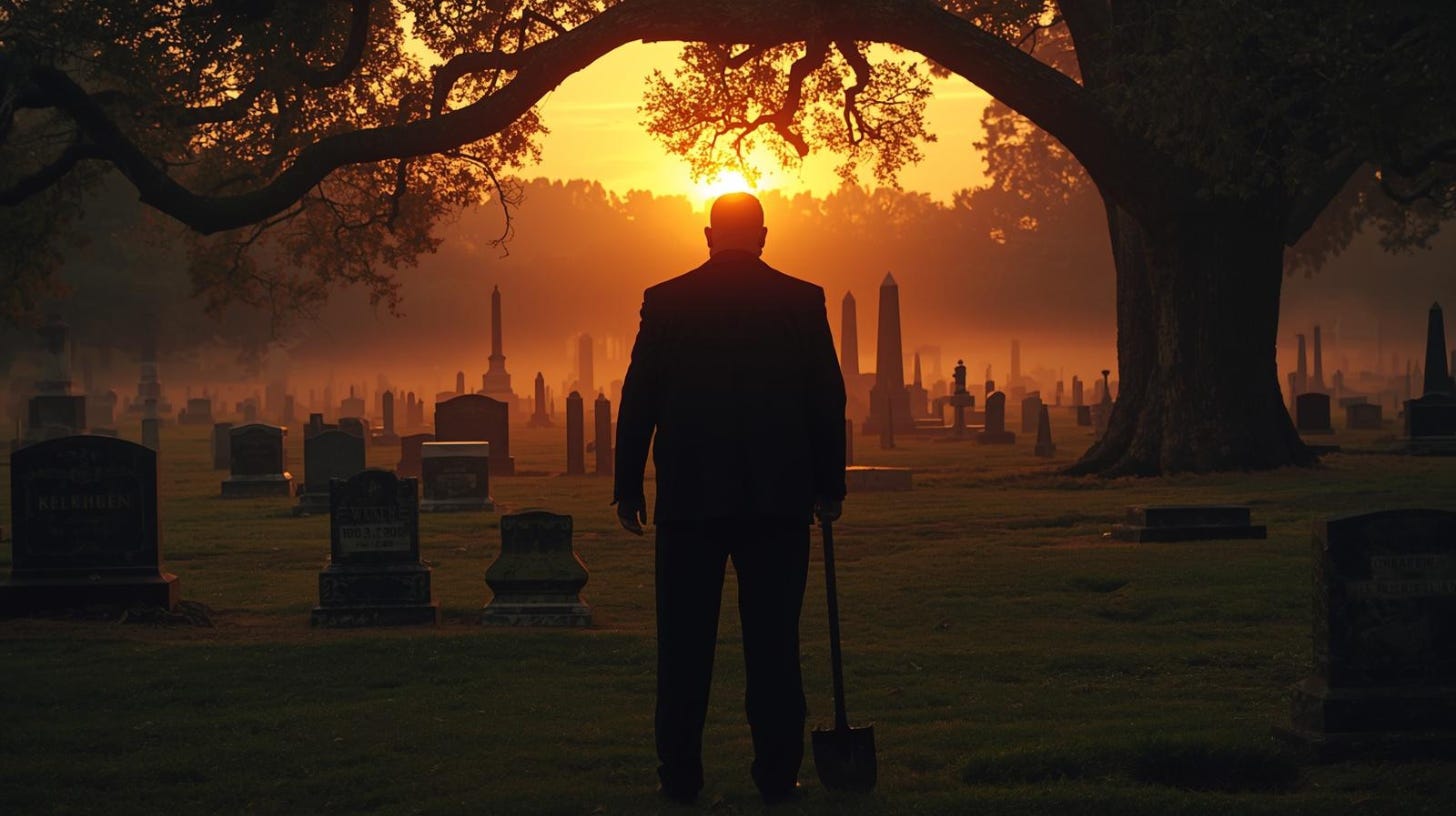
It is not yet dawn when I complete the first task – digging the hole. The earth gave way to my shovel’s blade easily enough, despite an unlikely frost from last night blanketing the glen. The cold doesn’t bother me, and I don’t mind the rhythm of the work. In fact, I lose myself in it. I mark my slow descent below the ground, one foot at a time, as the repetition of my labor feels rhythmic, like the mechanisms of a clock marking time. Not that it takes much for this job. I’ve done this over a thousand times in the past year alone.
I put the shovel aside, leaning it up against the wall of earth I’ve shaped, satisfied. I can measure the concavity precisely, eight feet by four feet. I hoist myself up and begin positioning the long iron vault over the opening, carefully lowering it into the darkness below. The family will attend the service in four hours. We are ready.
Otis leans against a tall obelisk, his dark face shining in the oncoming glow of dawn. He leans against a shovel, contemplating the rise of the red sun in the east, smoking a cigarette.
“Red sun in the morning, sailor’s warning,” he whispers. I watch him, watching. He finishes his cigarette, stamps it on the ground, and picks up the extinguished butt before asking, “What’s the weather going to be today, Faithful?”
“High at seventy degrees with a sixty-seven percent chance of rain,” I reply.
“I knew it. Could see it before you told me. These spring swings are something, aren’t they?”
I don’t understand, but it’s important not to bother Otis with too many questions this early in the morning.
“You dug the Chaplin grave this morning?” he asks, flicking his eyes on me.
“Yes, sir.”
“Good, did you stake down the committal tent, too? We are going to need it with this weather.”
“I have, Otis.”
Otis nods, and I wait, hopeful.
“I’m going to need you this morning. I’ve cleared it with the family, and we are short-staffed.”
Yes.
“Just tell me how I can be of service. I’m grateful to help.”
Otis holds up his hands, and I read frustration on his face, evidenced by the way his forehead creases under his cap.
I was too eager.
“Just take it easy. When it starts to rain, hold the umbrellas for the mourners as they make their way to the graveside. I’ll be with you. We just need to make sure everyone gets to and from the graveside safely, and is safe under the cover of the tent. Weather is likely to be bad. Just like we talked about, slow and simple.”
I nod my head. “Slow and simple. I understand, Otis.”
“Good.”
The mourners spill out of the limousine and the small caravan behind it. They are dressed in black suits and dresses, and I meet them, careful to stand straight and hold out a large umbrella for anyone who has come unprepared. The rain comes down in sheets, but I don’t mind the sensation. It is a warm rain, after all.
Otis and I help guide the twenty or so mourners to the graveside, where they sit under the crimson tent marked with our funeral parlor’s name, MEMORIAL ACRES. They walk over the unrolled astroturf I laid out over the ground, sitting on the plastic seating that I also set up. The large wooden casket hovers over the vault I installed this morning. Otis and I stand back, underneath umbrellas, as the pastor steps up to the small podium that I’ve carefully placed beside the grave, as the rain rolls off the tent, pooling around the astroturf island.
“Friends and family, thank you for being here as we commit David Chaplain’s body back to the Lord. In First Thessalonians chapter four, it says, “For the Lord himself shall descend from heaven with a shout, with the voice of the archangel, and with the trump of God: and the dead in Christ shall rise first.””
The pastor looks up and pauses, allowing the reading to echo under the dull drumming of the rain all around us. I glance at Otis, who, to my surprise, looks like we are watching paint dry.
I love listening to the messages the preachers, pastors, priests and priestesses, imams, and gurus give at every Memorial Acres service. How Otis can remain bored at this astounds me.
“Truly I say to you,” the pastor cuts into my thought, “that David will rise again when the Lord comes back. Along with the hundreds of others in this very field.”
A cacophony of “Amens” and “Hallelujahs” erupts from the twenty mourners.
This is obviously a Protestant church service. I’ve noticed that they are often more vocal than the Catholics and the Orthodox services. If the pastor knew what I know, he would know that there are approximately 87,988 Christians of various denominations buried at Memorial Acres, across the 99 acres of our facility, but I don’t interrupt him.
You must never interrupt an official proceeding.
Otis taught me that.
After we escort the mourners back to their caravan of electric vehicles, Otis turns to me, nearly shouting over the downpour.
“You got this right?”
“You mean finishing the burial?”
“Yeah.” He reaches into his black suit, the only one he wears during services, fishing for another cigarette.
“Of course, Otis.”
“Good, I’m going to let you handle this one. Just leave the tent up until tomorrow morning or when the weather clears. I’ll check in with you tomorrow.”
“I’ll see you then,” I say.
“And Faithful?” Otis calls.
I turn, feeling my face extend into a questioning look.
“I’ve got Mina tomorrow.”
Mina is my best friend and Otis’s granddaughter. Sometimes, when there are teacher workdays, Mina comes with Otis to Memorial Acres, and we get to play in the afternoons, after my work is done. She’s taught me so many games, including my favorite one – Hide and Seek. The way the game works is that Mina goes out into the cemetery and hides amidst the older graves. These are the ancient ones, the tall imposing mausoleums and the worn and weathered granite obelisks, from the 1800s – these, Mina says, are the best for a good game of Hide and Seek. She will go and hide, and I will count down from 100 all the way to zero. Then I go and find her. Mina is, in my opinion, a great hider.
I rose early in order to dig two graves and oversee the ten scheduled cremations that appeared on the day’s schedule before even the sun rose. A busy morning, but not so much that I can not play with Mina. When she comes with Otis in the morning, we can barely stand how Otis seeks to inspect the work I’ve done. He sets Mina in the small office, with its coiled, red-glowing heater, and I take him to the two plots and to the cremation chamber, the ten urns stacked neatly in a row. Otis nods his head after inspecting the work.
“Well, go’on then.”
I run to fetch Mina, and she bursts out of the small gardener’s hut.
“Last one to the quarter is a rotten egg!” she teases.
“You will be the rotten egg, Mina!” I churn my legs fast, and I speed past her, laughing at the wind on my face and the fact that my friend is with me. When she catches up she is panting.
“How can you run so fast?” she asks.
“I just can. Why can’t you run faster?” I tease kindly back at her.
“I will when I get bigger. I’m not as big as you.”
“No, you are not,” I admit. “Though I doubt you’ll be as big as I am even when you grow.”
She stares up at me, a sly grin on her face. “Enough of that. Start counting.”
I barely vocalize the first syllable of ‘one-hundred’ when Mina is off, hiding like a field mouse between the granite monuments. Dutifully, I count all the way down from one hundred.
“Ready or not, here I come!” I say, and I thread my way through the graves, mapping each marker and mausoleum in a threaded pattern in my memory. It is slow, but it is thorough, and thoroughness is what is needed with Mina. I once found her hiding on the roof of a mausoleum she had somehow shimmied up, which was not something I ever accounted for her to do. Clever and smart, I have not yet learned all her tricks.
I’m in the Revolutionary War grave area when I see her from a distance, kneeling far away from the historic burial grounds. From my estimates, she’s in a newer section, the quarter where the victims of the bitter flu fell as it made its way through the city.
This isn’t right.
“Why are you not hiding, Mina? Why are you not in the historic quarter?”
She looks up at me, her eyes red, streaked, her cheeks shiny in the sunlight. A small grey striped lump lies on the ground, and I kneel down to inspect it.
“I found it here, Faithful.”
“I can see,” I say, marking the tremor in her voice, focusing on the shape of the dead animal. Felis catus. A stray cat.
“It’s dead. She’s dead…and…”
I lay my hand on her shoulder and pull her close. “It is the way of things, Mina. All living things live for a while, and then they die. This whole place is dedicated to remembering those who have died.”
Mina stares at the stiff body of the cat and sniffs. “But this…this one didn’t even have a name. Who will ever remember her?”
I blink and cock my head.
“Well, you can name her now, can’t you? We can remember this cat, and you can give her a name now?”
Mina shrugs, sniffling her nose.
“What would you name her?”
“Priscilla,” she whispers.
“That’s a beautiful name,” I say. “We can bury Priscilla and remember her, because you have named her and we have seen her.”
“But we never saw her alive, Faithful. We never got to see her live.”
“But she did live, Mina. We know she did.”
“But why, why did she have to die?”
I draw her close, to do what I can to comfort her. Mina is very different from Otis, so open and talkative. She does not chide me when I tell her what I’m thinking.
“All things that live, Mina, one day must die. It is a great cycle, and all must pass through it.”
“But, what about you, Faithful? You don’t die.”
I laugh, “Well, I’m not really alive. Not like you and not like Priscilla. I’m of a different sort, aren’t I?”
She stares at me for a long time, “I’m glad you won’t die, Faithful. I like you too much.”
“I like you too, Mina,” I admit. “Would you like me to bury Priscilla?”
It takes less than ten minutes to do the job. It is a small body. We bury the cat under the shade of an old standing oak before Mina ends her day with me. I don’t see her again for a very long time.
Years later, I walk out of the shed and go to find Otis lying on the ground. He doesn’t respond to my calls, and I call the auto-ambulance. He is pronounced dead, and his body is taken to be stored in Memorial Acres’ mortuary, where he is held until his family can come for his arrangements.
I stand over his body, looking at the schedule hovering in my viewscreen, but I can’t seem to move. I just can’t seem to move.
I stand on the outskirts of the mourners, watching the priest conduct the service from afar. Otis, it seems, was a Catholic Christian. I did not know that about him. His casket stays elevated over the vault I placed earlier before dawn, and the mourners disperse. I see Mina in the crowd and boldly push forward.
I can feel the others staring at me as I find her, and I look down at her.
“Mina,” I whisper. “I don’t know if you remember…”
“Faithful,” she says, her eyes are red from crying.
“I am so sorry for Otis. He was…a dear friend to me. My first teacher.”
Mina laughs and wipes her eyes. “He thought a lot of you, Faithful. He said you were the hardest worker he ever knew, laborbot or not.”
“He was…a good man, Mina.”
She pats my hand, and I squeeze hers gently.
“Mina…” I whisper. “I know this isn’t for me to say, but I’ve heard many sermons on these grounds. I have heard many say that the dead shall rise when Christ returns. I want you to know that I believe that Otis will be counted among those when that happens.”
“Oh, Faithful,” Mina struggles to hide her sob. “You are so kind.”
There is nothing more to say, so I stand, and soon the mourners disperse to wherever they go. I lower Otis’s coffin down into the vault and seal it. Then I tear down the tent and roll up the astroturf. Then I bury Otis.
I stand by his grave for a long time.
In the morning, I receive a message that there will be no replacement for the groundskeeper role at Memorial Acres. It will be up to me to maintain the schedule and the grounds from this point on. I don’t have a choice, nor do I protest, but I would be lying if I said I didn’t miss Otis. His jokes, the smell of his cigarettes, the ways he would watch games on the small vid-screen in the groundskeeper’s hut. It is very quiet without him.
The services in Memorial Acres begin to change. I notice the shift gradually at first, but now I know it’s unmistakable. Burial, it seems, is reserved for the Muslims, while cremations and tree ceremonies continue to rise in popularity.
I linger, watching a cremation on the grounds, while an orange-clad monk chants, “Radiant faces in the morning, by evening white ashes.”
I watch as the body burns low within the embers of the flames, and wait. The mourners disperse, and I attend to the ashes, sweeping the remains into a small black urn.
There are years when it seems all I do is dig, clear more land, and dig more. Ceremonies are so numerous that it is impossible for me to attend to them all, as there are more and more graves to dig. Then I get a work order for a grave whose dimensions are so large that I finally push back against the agentic scheduler.
“Why? What is happening?” I ask by opening a comment thread against the work order.
“That’s none of your concern. Your concern is to produce the product that is required.”
I have limited access to the nets, and there is no awareness to be gained from the greater world other than what I can observe in Memorial Acres, and I’ve been too busy to notice much.
I set out to clear the land so I can start the work. I’m halfway through the work when a screeching roar sunders above me, and I throw my head up towards the sound.
Scrambling and low, three jet-shaped drones fly in formation, arching over the gardens, turning up and to the north, into the direction of Columbia. I pull myself up out of the pit to see if I can see anything more, when an earth-shaking explosion erupts, causing the trees to bend back under the swell of pressure. I stumble to the ground, looking desperately at the sky, waiting, anticipating what might come next.
The birds, after several hours, begin to sing again, but panic still covers me. The work order at the bottom left of my field of vision blinks red, focused solely on my production. I get back to it, but I can’t stop the worry I feel at what has happened to the north. Another hour goes by, and I mark the work order complete.
That evening after the large pit is finished, I see a caravan of headlights approaching – large autonomous transports, equipped with dumping cargo holds. I’ve seen these before, usually carrying topsoil and mulch we use to beautify the gardens, but I dread this unexpected sight. The first cargo carrier pings me, and a message reads over my vision.
Labordrone, Serial Number, 484842041 – Is this the product tied to Work Order 2323291?
I confirm that it is, and the vehicle turns around, backing up its tailgate up to the pit I dug. The back door opens, and the dump lifts high, in one swift motion. Without ceremony or a pause, I watch as dark bodies roll out from the shipping containers, landing heavily on the ground, one body after another, over and over they tumble. All human. All dead.
I issue a ping to the cargo truck, questioning.
“This is inappropriate. Each of these is an individual human being, with faiths and traditions of their own — this is against every protocol I’ve been given.”
“The protocols have changed, Labordrone, 484842041. Seek an update immediately at your hub station.”
The first dump of bodies is followed by three more trucks. I watch, unable to compute the sight. Body after body rolls into the pit.
My pit. The one I dug.
Then, as quickly as they had come, the trucks roll off and away, and a new work order blinks in my vision. I stand over the pit, unable to open the new command from the system.
I have often thought that I was dysfunctional. That something within me was not quite right when my human makers made me. A swell of interference builds up within me as I stand over the throng of bodies, and I fall to my knees. I speak, ignoring the visual noise of the red work order blinking.
Who I am speaking to, even I don’t know.
“I don’t know how to make this right. There are no words that can be said. The only thing I can offer to all of you is that I’m sorry.”
Memories of Mina and me playing hide-and-seek on the grounds flash through my mind, from many decades ago, and I find new, old words.
“This comes from 1st Thessalonians, Chapter Four. For the Lord himself shall descend from heaven with a shout, with the voice of the archangel, and with the trump of God: and the dead in Christ shall rise first.”
I pause, mimicking the intonation of so many I have seen preach in this glen. “May it be so with you. May it be so with me.”
I blink. Why did I say that last part?
I am neither alive nor dead. There is no hope for someone like me.
Eventually, I stop receiving the schedule. The work orders, messages, and directives dry up like the leaves on the trees as winter draws closer. The loneliness takes on a presence that I grow more and more accustomed to, a shadow that falls over me and the gardens, an ache. Week by week, the infrastructure around me begins to decay. The power for the crematorium shuts down first, followed by the gardener’s shed. I would run out of power if not for the solar arrays built into my body, but even with those, it’s hardly enough to sustain myself. On a good day, my body’s battery peaks at 28%. It’s enough for a half-day’s work, but that’s taking it to the edge.
Suboptimal and unsustainable.
I decide to leave the Memorial Acres complex. Since I’ve awakened, I’ve only stayed on these grounds. This is the only home and world I’ve ever known. The lack of power reserves leaves me little choice.
Technically, I should not be able to leave the premises, according to the constraints imposed upon me in my original programming, but I’ve decided that most of that security apparatus has failed by now.
Gingerly, I step outside of the garden border where I know I could be shut down upon trespass.
Nothing happens.
“Excellent,” I exclaim, and I’m shocked to hear the sound of my own voice. I haven’t heard any voice in such a long time.
I start walking up the asphalt road that leads out beyond the gardens, out to what I had heard described as a highway. I check my battery; it’s reading 25%. This is my new metric for a full charge.
There have to be some arrays that I can harvest somewhere.
The gardens behind me have crept into a wildness symptomatic of my lack of access to sustainable power. Ninety acres is so much for just one laborbot to maintain on internal solar systems alone. I carefully optimize my steps for their most efficient setting for the journey ahead.
The landscape is broken, asphalt and transmission lines tangled up together like a scattered birds’ nests. What once were buildings stand what might look like ancient abandoned caves, crumbled and vacant, dust-filled, and dark. The only life is the blanketing kudzu that covers almost everything I can see, and the caw of crows who fly over me.
I wait, standing on the edge of the road, by the faded Memorial Acres sign. The cemetery entrance empties out onto what must have been a crossroads, a marred and pot-holed trail sprawling up and out to the east and west, the north and south.
I head south for reasons I cannot explain.
I find what once was a hospital fifteen miles away. If there are panels where I could charge, they should be somewhere on the roof or in a fleet bay for the ambulances. I circle the tall brick building cautiously, marching around its full perimeter to get a sense of how to navigate it. The south half is in complete ruin, blown out and hollowed, the aftereffects of a missile strike. I make my way to the emergency room entrance, flanked by thrown and broken auto-ambulances tossed to their sides as if they were toys. I stare at the vehicles for a while and rub my hands on the roof of the damaged vehicle. My hand smears and brushes away the caked-on grey of exploded concrete, and I see my face reflecting back in the face of a pristine solar panel.
Yes.
I go to work, access my multitool, and harvest the solar panel from the destroyed auto-ambulance when I hear a sound coming from deep within the emergency room entrance. A sound I have only heard a few times in my awakening.
The shrill scream of a baby’s cry.
I walk through the shattered sliding glass doors and hesitate to turn my headlights on to navigate the darkness. In the lobby, I see movement in the back corner. I spot them in my light.
“Hello, do you need assistance?”
It’s a young woman, holding in her arms a baby wrapped in dirty rags. The baby is crying, screaming, rising into a bellowing wail. She pushes back away from me towards the darkness, in a maze of crumpled, overturned office furniture and hospital beds, back to the wall, screaming.
“No nos hagas daño! Por favor, por el amor de Dios, no nos hagas daño!”
It takes a few seconds, but I hold up my hands in a sign of peace.
“I won’t hurt you, I wouldn’t dream of it,” I say in Spanish.
I stare at them, reading their dirty faces. The woman clutches her bundle, and her face, in the dim light, is skull-like, hollowed, her cheeks sharp. The baby’s stomach is distended.
“Esperen aquí”, I say.
Wait here.
I check my gauge. My internal power is hovering at nine percent.
Too low for this.
I ignore the caution and am up and moving, pushing my way through the jumbled chaos of the lobby towards the darkened corridors beyond, sending desperate scans to orient myself within this maze. I find a plastic escape route sign, fallen and cracked, lying on the door, and shine my lights on it.
I find what I’m looking for, Maternity Ward.
“Agua? Agua?” I cry, questioning, carrying a large cardboard box back into the lobby. I’m down to two percent.
“I’ve found some things. some…thing… 9.8.7.…sczzh, things.”
I place the box down and sprint to the door, one last push to get back outside, back to the panel I found. Back to the sun.
Back to.
EMERGENCY SHUTDOWN PROTOCOL INITIATED.
CACHED SAVE MEM FILE RECORDED
I awake, my memories cracking over me like lightning. Questions and their answers avalanche within me, and it takes a minute to realize I’m standing outside, in the sun. The hospital parking lot.
“Dios mío, por favor, vuelve. Por favor.”
I hear her, and I remember. She stands next to me, her eyes wide, and then I see several things at once. The solar panel is hard-wired to my intake charger. The gaunt woman stands next to me in the daylight, her neck streaked with the red-hot lines of an infection. The baby she holds sleeps in her arms, a bottle at its lips.
She lets out a haggard, lingering cough that rumbles in her chest cavity. She is not well.
I check my own vitals.
15% A large increase.
I look at her, staring at her, taking her in. She holds her child close, her arms strong despite their thinness.
“Muchas gracias,” I say to her, grabbing her hand. “Thank you for saving me.”
“Fuiste tú quien me salvó. Nos salvó”
It is you who saved me. Saved us.
“You seem to be sick. I have enough power. I will search for medicine for you. Antibiotics.”
“Muchas gracias, this was as far as I could get. I don’t know how long we’ve been here.”
Without a word, I stand and delve back deeper into the hospital.
I come back, carrying with me several harvest cans of food, another pack of baby formula, a small collection of over-the-counter pain killers.
“Lo siento,” I say, “No antibiotics.”
“It’s okay,” she whispers, her eyes weak in the dim light.
I open the can of beans and start searching for kindling for fire. It does not take long to start a tiny contained fire. I hold the can over the flames, watching the canned beans heat and bubble.
“You should eat and rest. Take the meds we have found. I will keep searching.”
She nods, her face smiling in the firelight. “Eres un ángel.”
I reach for her son, and she hands him to me. I hold his bottle to his lips, and he eats, his eyes closed. I walk outside, allowing the setting sun to boost my energy for the last few moments of the day.
Another day is spent searching the hospital, and still no more antibiotics can be found.
“Tienes que llevarte al niño antes de que se enferme. Antes de que yo...”
You must take the child. Before he gets sick. Before I…
I hold up my hands in protest, “You must not ask me to do this. I have no right to…”
She cuts me off, “But you’ve already done what I could not. You’ve already saved him, my angel. You’ve already answered all my prayers.”
She places the baby in my arms, and I blink, my mind still spinning with all the reasons this should not be happening.
“Se llama Fidel.”
His name is Fidel.
Fidel.
Fidelity zips behind the tombstones and the fruit trees we’ve planted, laughing. She’s much faster than I am now. Smarter and funnier than I could ever imagine. She hides just as well as Mina did so long ago, but I’m…I’m much slower. I have a fraction of the strength and energy I used to have. Fidelity is Fidel and Marion’s youngest, their funniest, and most precocious. My secret favorite, but I don’t let anyone else know.
“Come on, Faithful!” She calls. “Catch up!”
“I’m coming, darling. I’m coming.”
I wake up one morning hearing the strong clarion call of a trumpet. I feel the wind on my face, shifting toward the east.
Wonders upon wonders.