


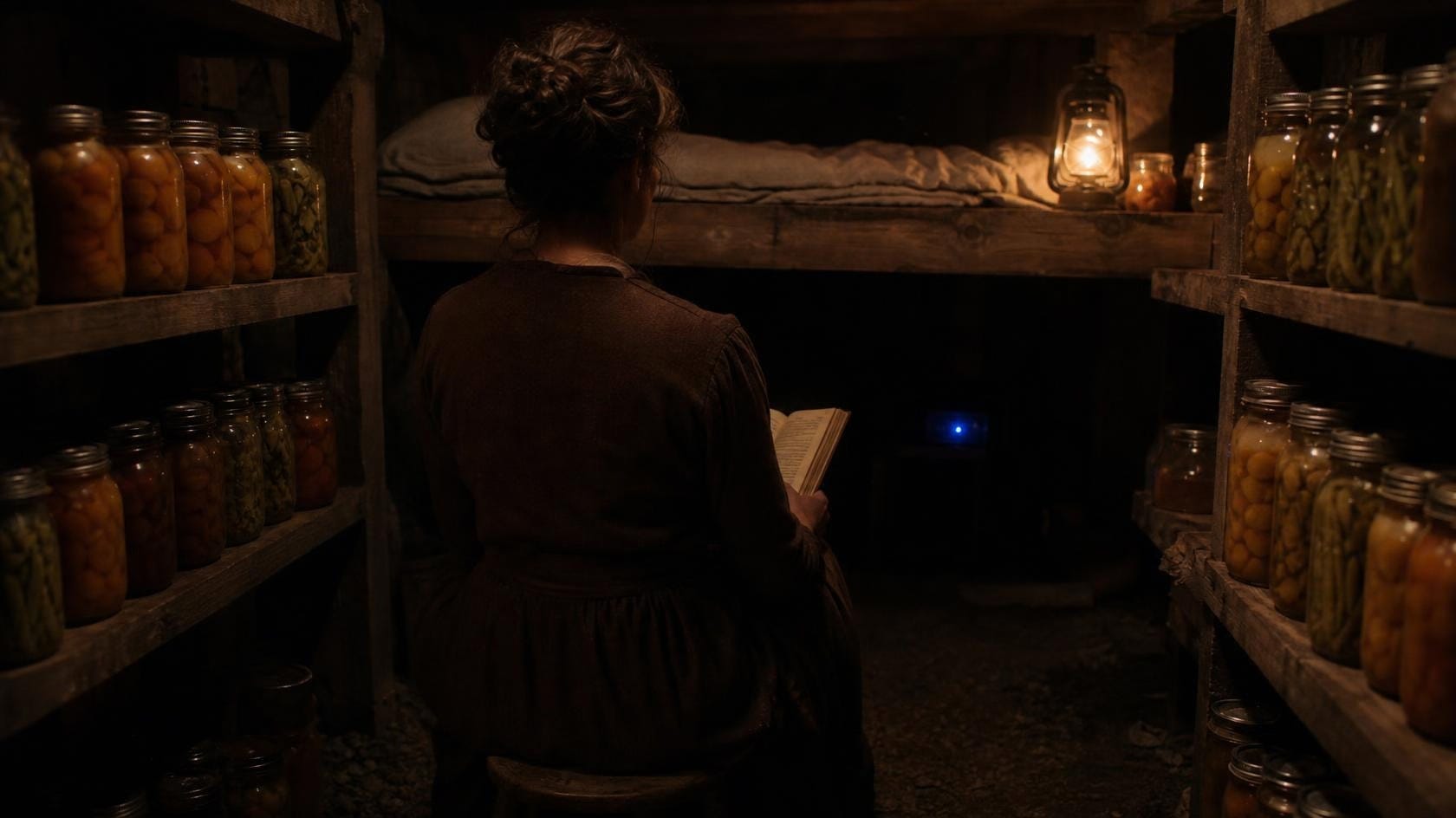
This is a continuation of the Franklin family story. See “Watch the Road” & “Exile” for more.
This story contains explicit language.
Sandy remembers the first time she saw him. She came through the double doors of the campus library, nursing a hangover, anxious about an impending Shakespeare exam.
Shakespeare. Why does it have to be Shakespeare? she thought.
Why do you care so much? Another thought came in swinging. You think all your sisters are this concerned with their exams?
Stop. She didn’t have time for it. It didn’t matter what the others in the sorority thought. What mattered was her own commitments. She had a Shakespeare exam, and because of that she was going to do her best to prepare, hangover or not.
The vise between her temples mocked her as she slowly weaved her way towards the staircase.
You’re welcome, future-Sandy. Love, past-Sandy.
God, why did she do this to herself?
Somehow, she made it to the bottom of the library, where the study carrels sat like large abandoned relics. She dragged a five-pound tome out of her bag. The Complete Works of Shakespeare. The professor had insisted that every student buy the physical copy of Shakespeare’s complete works. A physical copy. God. She flipped to the middle, to Hamlet, and tried to connect there to the bard’s tilting verse. It was hard trying to find some place to hook her 21st-century mind into the merry-go-round of Elizabethan English, all while the words swirled on the page and her head throbbed in time with her heart.
God, Sandy, you really tied one on.
Her eyes hovered over the third act of Hamlet, and she began to read.
To be or not to be—that is the question:
Whether ’tis nobler in the mind to suffer
The slings and arrows of outrageous fortune,
Or to take arms against a sea of troubles
And, by opposing, end them.
She stopped, pressing her fingers to the bridge of her nose, the pain in her head building up to a crescendo.
I wouldn’t mind ending mine, right now, bud. This is useless.
“You know there is a better way to experience that, right?”
The voice called over her head, and for a minute she thought it was directed at someone else.
“Miss?”
Sandy popped her head out from the study carrel like a gopher, that is, if a gopher had fallen into a barrel of moonshine. She saw a man standing in the far-right corner of the room, by a newly installed study room she’d failed to notice. He was tall. Wore small glasses. Muscular build.
Sandy briefly thought she was hallucinating.
“I don’t mean to distract you, but I’d love to show you something. I couldn’t help but notice what you’re studying. Bill Shakespeare can be a little tough. You got a minute?”
Sandy blinked, trying to reestablish her bearings. She laughed at that, calling the bard Bill. She looked down at the text on the desk, the words still swirling on the page.
Shit, what the hell.
She stood up. “Sure. Show me what you got.”
“Great, come on in.”
The man held the study room door open.
She walked through.
“What’s your name?” he asked.
“Sandy. Sandy Weaver. Yours?” Why did you tell him your full name, you dolt?
“John. John Franklin.” He held out his hand like this was a normal thing two young people did, meeting each other formally as if this were a job interview, and for reasons Sandy didn’t quite understand, she grabbed his. They shook, this connection lingering just a bit more than necessary, a bolt of current vibrating as their hands touched.
He had blue eyes.
John was the first to let go of their shake.
“So what do you got for me, John? I’ve got an exam tomorrow, so…” She smiled, but she felt a growing annoyance. Is he just trying to hit on me?
“I’m sorry,” John said, his voice stammering. “I just saw you studying, and thought this could help.” He flicked a switch on the wall, and Sandy noticed that the wall behind him held a floor-to-ceiling panel of electronics that erupted with humming, new life.
“Have you ever used a neurolink device before?” he asked, reaching for a headset hanging on the wall.
“I don’t even know what that is,” Sandy admitted, her face crinkling up in a dry smile. “I’m not much of a techy person.”
“That’s okay. This stuff is fairly new. I’m in the engineering program, and I’ve got an internship with a startup that’s been developing this technology. The thing is, you know you were never meant to read Shakespeare. You were meant to see it.”
He held the headset, smiled, and placed the device on his head. He reached for a second one.
He looked like an idiot to her.
“Come on, let me show you,” he said.
She opened her mouth and looked back at the dry study carrel.
What the hell.
“Okay, you’ve got fifteen minutes.”
“Deal.”
He put the device over her brunette curls, careful to connect the electrodes against her temples.
“This won’t hurt a bit. Are you ready?” he asked.
She didn’t have a chance to speak before the whole room exploded with a blazing white light.
Fear. An uncontrollable fear met her in the blazing white light.
Well, great, Sandy. You’ve gone and done it. You’ve found the lone mass-murderer who stalks the campus library looking for stupid women who should know better.
The light faded, and she blinked. She found herself standing in a lush open field, the rosy fingers of dawn melting in the sky underneath the canopy of a large, wide oak tree.
How did she get here?
The wind blew through her hair, and it was as if she had walked into a dream. A man was standing next to her.
This John.
“Come on, you aren’t going to believe what you’re about to see,” he said.
Sandy could not find words; she was so disoriented.
“Where…where are we?” she asked.
John laughed. “If I explain everything, it ruins the surprise.” He turned his head to the left, and her eyes fell on a sprawling medieval city nestled beside a broad, brown river, shrouded in plumes of ash rising from a thousand chimneys.
“Come on, or we will miss it,” John said.
“Miss what?”
“You’ll see,” he said.
The afternoon flew by Sandy like a lucid dream. In the crowded Globe Theatre, she watched a production of Hamlet with bated breath. Here, she was so overwhelmed by all the sensory experiences of this living world that not once did she think about it all being simulated. How could it be simulated?
It felt so real. And yet, she could not believe she was sitting in the exact place that produced and showcased these famous works of art, these stories that had echoed through time, vibrating across generations for hundreds of years.
Hamlet stood on the wooden stage and looked directly out into the audience. Directly at her.
‘Tis now the very witching time of night,
When churchyards yawn and hell itself breathes out
Contagion to this world.
Now could I drink hot blood
And do such bitter business as the day
Would quake to look on.’
Next to her, she could feel this man—her shy, handsome guide—who had brought her to this place. Without hesitation, she reached out her hand towards his and found it.
Okay, Sandy, what are you doing?
She buried the voice. After all, was she really holding his hand, or was this, too, just part of the illusion?
It didn’t matter.
She leaned in, whispered, “Thank you.”
He whispered, “My pleasure. This is how it was always meant to be seen.”
He did not let go of her hand.
That was how it began. If she had known where it would end up, would she have made the same choices?
Yes. I would, she told herself.
At the mercy of a stranger, facing a future she couldn’t see. Her husband. Her children — Jesus, her children—both sons adrift somewhere. Lost? Dead? She didn’t know. She could not be sure.
That was what bothered her the most.
She didn’t know.
Their world had changed on a sunny Friday afternoon. She was pregnant, obscenely pregnant. It was as if her belly were a wrecking ball, threatening to collide with anything she could not see, or anyone dull enough not to give her a wide berth. John had stepped into their kitchen, home early from his job that Friday afternoon. She read his face in a millisecond. Something was not right. It looked like someone had walked over his grave.
“John? What is it?” she had asked.
John’s eyes were wide, and he teetered, standing in the kitchen. Sandy had never seen him like this. He stumbled towards the counter, sat down on a stool, and dropped his briefcase on the floor.
“I need some water,” he whispered.
Sandy waddled to the cabinet, filled a tall glass, and pushed it across the granite countertop.
“What is wrong with you? What is it?” She remembered smiling then. The day was beautiful. It had been September, hotter than it should have been, but altogether lovely.
“Sandy,” John whispered. “We need to get out of here.” His blue eyes tunneled into hers. “We need to sell the house and get out of Raleigh.”
Sandy froze as a million questions exploded in her mind. What the fuck was he talking about?
“What are you saying, John? What happened?”
John stood up, took out his cell phone, grabbed hers, and then took out the shared tablet that they used in the house. He placed them all on the kitchen counter, filled the blender with water, and ran it at full blast like a madman.
He grabbed her hand and took her into the back bedroom of the house. She glanced at the crib that John had set up the previous weekend in the room across the hall. His hands were shaking. As they walked into their bedroom, he shut the door behind them and turned to face her.
“Do you have anything on you? Earbuds, devices, anything?”
“You’re scaring me, John.” Whatever the hell this was, she could not handle it. Not here. Not now.
“I’m scared too. Do you trust me?” he whispered.
She was at a loss. Was this some sort of test?
“What IS IT?” she demanded. “Just tell me, now.”
He sat on the bed and ran his fingers through his hair. He took off his glasses and stared at her, as if trying to assemble the fear in his mind into a logical story.
“Today…you know Reggie, right?”
Memories of a holiday party came to mind. A large conference room at one of the downtown hotels. Beer and wine, good stuff, not cheap, and a man, tall and boisterous, always wearing a bright bowtie. His signature style.
“Of course. The guy who wears bowties, right?”
“Right,” John whispered. Then he began to speak, rapid-fire, as if his whole life depended on telling this story as fast as he could.
“We were running a frame through a simulation today, Sandy, just to test out its capabilities. We built a simulated power plant, standing up the infrastructure and mechanics for the test, with real assets networked.”
Sandy’s eyes clouded over at the jargon. “I don’t know what this means, John.”
He cut her off. “It doesn’t matter, but it was a real test, a real way to see how the model could scale, might scale to cause chaos against infrastructure, okay? Think power plants, government data systems – that kind of stuff.”
“Okay,” Sandy whispered.
“The model got through the firewalls in less than a minute, industrial-grade stuff, and the asset, like the physical device that we had networked, blew up, exploded in a fireball right there in the lab. Mind you, this was a model loaded into a frame, a robotic frame. We had only given it access to a public networked computer. Do you understand? It was incredibly limited in what it could do…or so we thought…”
“Okay, John, I think I understand.”
Tears welled up in John’s eyes. “Sandy, Reggie died today in the lab.”
“What?” She felt her mind zoom out in that moment. For a second, she could see them both, her standing in the room, her ankles swollen and aching, and John, sitting on the bed, his hands beginning to shake again.
“He died today. He went to shut the model down after the test… and it happened so fast,” he choked up. “The frame stood up and crushed his throat in less than a second, nearly snapped his head off. It took five of us to bring it down to shut it off, but we were too late.”
“What?”
Boom. She connected back into her body, and it swelled with fear.
“We have to get out of here, Sandy. The executives came down and assured us that his family would be compensated and that we would receive hazard pay. But the project…the project is still greenlit.”
“I…don’t know what to say, John. How could Amity do that?”
“Compensated,” he whispered. “Like his life was a rounding error on a spreadsheet.” He stared at her.
“Can you report it to the government?” she asked.
“And what do you think the government will do, Sandy? To Amity? A fine? A slap on the hand? And what will Amity do to me if I go forward? To us? It’s too late for any of that. We have to focus on ourselves now. On Cade.”
He looked at her belly, his eyes staring over an abyss only he could see.
“We need to get out of the city and go west. To the farm,” he said.
Sandy had lived in Raleigh her whole life. Even when college came, she had chosen to go to State. The Franklin family farm was out in the middle of nowhere, lodged somewhere deep within the sticks between Wilkesboro, Morganton, and Statesville, in a holler of the Brushy Mountains, right where the earth began to roll up to meet what would become the Blue Ridge.
“You can’t be serious,” she said, her voice catching in her throat. “What about my job? Yours?”
“None of those things matter, Sandy. Not anymore. Don’t you understand? This is only going to get worse. If you want our son to have a chance at living, I am telling you we have to get out of here. Out of the city. I can’t control what is coming, but I know in my bones we have to go.”
She began to cry, and she hated herself for it.
God damn it. Her body, her emotions, everything was just a mess.
“I don’t know how to process this, John. I don’t know what to do with it,” she finally whispered.
“I don’t either,” he said, staring out the window. “I’m going to go to the farmhouse and see what we’ll need to do. It’s been vacant for years.”
He paused and stood up. “I’ll be leaving in a few hours. Is there anything you need?”
He had already decided. He had already fucking decided.
She blinked, her tears drying up and giving over to hot rage.
“You don’t just get to decide for us both, John.”
He stared at her. He nodded his head. Was that confirmation? Or just a sign that he had heard her?
“I’ll be back tomorrow morning. We can talk more about it when I get home. I love you.”
And with that, he packed up a bag, got in the car and left.
Sandy walked into the kitchen, her eyes staring out the window as he left. On the counter, the blender roared, still running. She got lost in its hum, and she felt her baby kick inside of her.
What were they going to do?
Sandy sits by the creekside, her mind feeling like an egg cracked open. Runny and falling apart. Her hands can’t stop shaking. Cade is next to her, trying to help her to her feet, but she can’t move. She feels pinned to the red clay that cuts through the land like a high jagged wound. She can’t find enough strength in her legs to even stand. Her son is shouting over her, but she can’t even hear him; her ears are ringing so much. Cade’s face is painted with fear and anger, and Paul stands beside him as both boys work to lift her up to run. To keep running.
What are we running from?
She had had Cade in the hospital. John had relented to her. She had won that battle, but not the war.
The farmhouse was in terrible shape. There had been some long-term renters who had abandoned it five years ago, and the whole place stunk of wet dog and rot. John got to work rehabilitating the structure with a manic, unnatural energy that frightened Sandy to her core. He had resigned from Amity the following Monday and had gone up to the farm as the project’s sole craftsman. Still pregnant but close to labor, she went with him, finding herself staying largely outside of the house as he worked to restore the structure.
The land was beautiful, but it was not enough to stop her from crying. She kept crying, trying to piece together how their whole life had spun out of control, and how the stability of good, steady jobs, benefits, friends and a decent community in Raleigh had disappeared in less than a single week.
She was so angry.
As the weeks went by, within the chaos of everything changing, their house sold easily enough, and John sold most of the furniture and everything they no longer needed online. People rolled up to collect the pieces and parts of almost everything that had defined their lives together in a single weekend.
“None of this will fit in the house anyway. We will need tools and farm equipment, not furniture,” John said.
For days, she couldn’t speak to him. Her rage was kindled and stoked anew with each item that went out of their Raleigh house they had built together. Sold to some stranger who picked it up and carried it off their front porch.
Then a few days later, her water broke, and they rushed to the hospital. Another blurry and consequential moment in a never-ending chain of discordant, mixed memories. She had borne the pain of the labor with a resolute strength she did not know she had. Somewhere in the terrible process, in the middle of the swelling, back-breaking waves of pain, she went somewhere else. To another place. Her mind exiting the sterile, burning white hospital room.
She was at the damn farmhouse. Standing outside of it, except it was not dilapidated. It was restored and renewed. John stood on the porch, looking at her, wearing a long beard she did not recognize, and beside him was an older boy, their son. Cade. This same boy who was on his way to join them now. She spied something else held in John’s hands. A bundle. Another baby. Another baby.
A voice penetrated her mind as she screamed through a contraction that broke over her, somehow bridged in both places, standing in a thin doorway between two realities.
“Go,” the voice said. The single word was completely outside of her as she stood surrounded by this vision that could not be real. At least not yet.
She could never explain it, but it was at that moment Sandy gave in and let go, allowing herself to embrace this terrible new thing that stood at the threshold of all their lives.
She would go. She would embrace this as her life, as humble and worrisome as it was. She would let go of who she thought she was. As tears poured out of her eyes, she had simply said, “Okay,” and the blazing light of the hospital came crashing back over her. She was back, and she heard the nurses saying, “Push!”
Cade came in that moment, followed by an immense wave of relief. The world shifted all over again. John was next to her, crying. He held their son, and she saw her husband for the first time in a long time. She found his blue eyes.
They were together. For better or for worse.
Okay, she thought.
I’ll go.
It took a long time for the farm to feel like home for Sandy. The isolation and the slow cutting away of their previous life felt like dying to her, but she endured it. John completely rebuilt the house and ensured it was sound, but it remained very humble. Their living room and kitchen in their previous house were nearly as big as the bottom floor of this place. Sandy had held Cade on the porch that fall, rocking him as John worked through the day up until sundown. By the end of fall, he had traded their two vehicles to secure a small farm tractor and enough homesteading equipment for a whole community, let alone their family.
Burn all the ships. That was what Cortés had done. There was no going back now.
That first year was rough, but they learned soon enough, getting into the rhythm of the land around them, learning from the lessons it had to teach them. It was a harsh mentor. That winter they survived on a pallet of bulk potatoes that John had purchased from another farmer. Sandy had learned to cook potatoes in every way under the sun, until they were both sick of it. But it was the perfect circumstance to get out into the earth and learn how to grow their own food. And they had.
Somewhere along the way, John got reinterested in religion, quietly reading a Bible on the back porch in the evening. Sandy had at first recoiled at this, wary of what this new change would mean.
Her only ritual was to put Cade down and listen to the small radio for news of the outside world. Early in their move, John had completely severed the house from the grid, building a small solar array and battery bank to keep the fridge and freezer running. He had kept one network connection to the outside world to monitor the news from the tablet they had brought from Raleigh.
Everything else went rustic. Firewood and the cast-iron stove became their primary means of cooking and warming themselves. Their bodies both grew hard with the labor of it all, but Sandy found herself retreating to listen to the radio, trying desperately to tune in to the public radio station that she could catch through the static from Hickory.
And the news was not good. It was never good. Year after year, tragedy built upon tragedy, and then it all turned over. The last radio broadcast she allowed herself to listen to was when President Boswell declared a new war against Iraq and put out the call for volunteers. That was before the mandatory drafts of all able-bodied men, and before John started building the perimeter defenses.
She had started walking by herself then, abandoning the radio and choosing to hike around the property. John didn’t question this, nor did he intrude. He must have realized she needed this time. She did her evening walk every night that summer, and allowed herself to blend into the quiet of the oncoming twilight. She could feel her own transition coming, something shifting within her. The land was slowly drawing her in, and she could feel a wider world unfolding on these walks, surrounded by the rolling hum of cicadas, the call of the whippoorwills and the cackles of coyotes erupting over the ridge. All of it, the beautiful and the dark, was there; its delicate synchronizations and patterns of balance were bigger than her, yet she too was a part of it all.
She had noticed a shift in John, too. His worries and anxiety were fading, and what was in their place was a steadiness. A curious peace, as if he had tapped into something bigger than what she could see.
She had come to him one night in early August as John was reading from the Psalms on the back porch.
“What are you reading?”
He glanced up at her. “Oh, just a Psalm.”
She had stared at him as the whippoorwills began to sing their low, mournful songs, announcing the coming darkness.
“Read it to me.”
So John had begun reading, and they had begun discussing, and somewhere in that practice Sandy began to trust that somehow what she thought were only myths and legends had something more for her than she could ever suppose. She saw herself in the stories, and a thread of a new perspective began to take root, grow and eventually blossom. Despite all evidence to the contrary, she began to believe that her small family was destined to make this choice and that something bigger was watching their every step.
Paul came not long after, and then Boswell called for the draft. A year later, the Turning happened, but John had already severed the house from the nets and begun trading with others within the underground market. Sandy watched as he focused his sheer will on protecting them, building the landmine border to defend first against the Union and then against Amity with a restless, relentless energy.
They were running. Down and out of the creek bed in the cover of darkness, their faces, hands and clothes caked in red clay dirt. She ran with a stitch in her side, carrying the shotgun, five shots loaded, ready for whatever came next. Behind her were her sons. Cade, now taller than her, his eyes wide in the darkness, and Paul, holding his brother’s hand, helping him to keep running at her pace. The two hounds ran ahead of them, rushing ahead with some instinctual purpose. Behind her, John carried the heavy dampener, strapped to his back, the low pulsing sound of the device’s energy resonating out and around him. He had turned the machine up as high as it could go, and they sprinted.
Sandy held the shotgun to her shoulder with the safety off. She let the boys take point, and she turned around. John ran behind them, and behind him she saw movement. Terrible movement in the dark. A vibrating, pulsing mass that swarmed within the darkness. Glints of flickering starlight caught flashes of what chased them now, coupled with the sound of mechanical sprinting, like a giant centipede clicking and clacking. It reminded Sandy of the sound of her old car battery gone dead, clicking with a manic, terrible energy, striving to find life, to turn over, to ignite. Single circles of red light erupted through the darkness, painting them all in a crimson glow, burning only feet from where John sprinted.
She drew her shotgun up, pointing over John’s head, and her husband screamed, “Save it, Sandy! Save your shots!”
She saw then the form of her enemies. Low, crawling, mechanical, spider-like, they came—sprinting over the terrain like a pack of predators, spewing up and over the creek beds like an oncoming wave. As they drew near John, they hit the invisible border of the dampener field and fell back, their red lights put out, but each extinguished nightmare was renewed and replaced by another.
“Keep running! Keep running!” John screamed, and Sandy saw him stop, turn and lob something she could not see out into the darkness.
No.
A terrifying explosion of rushing air and fire ripped through the creekbed, and Sandy felt her body get lifted and shot through the air like a bullet.
She hit the ground, and she felt the air hammer out of her lungs. Cascading pain ran up her side, and she sat up, trying to understand what was happening. Her sons were by her side. They lifted her up, and she saw Cade pick up the shotgun and rush towards the smoldering, still-burning hollow of the creek bed.
What were they running from?
Paul screamed, “No, Cade!”
Five blasts, dull and muffled through the ringing in her ears, emptied into the night as Cade fired against their enemy in the darkness.
Sandy lifted her head and opened her eyes. She could barely piece together what she saw. John’s body lay on the ground, crumpled in a heap amidst the river rocks. Cade stood sentinel over him, the shotgun’s muzzle flash illuminating the darkness with each terrible, booming report. Each shot showcased a terrifying mob of robotic spider crabs circling them. Behind them, seven humanoid figures stepped out of the darkness, all wearing Brad Williams’ face, their smiles malicious.
God. No. Please. Not this way.
Sandy screamed as the four Brad Williams drones moved to lift John’s body up and out from the creek bed. The other three went to pin Cade to the ground. She screamed and screamed as her son and husband were taken and carried up by these monsters, pulling them back towards their abandoned, overrun home. She reached out for Paul.
Paul?
Paul was gone, along with the dogs. Spirited away in the darkness of this hellish night. She was alone.
She sat up and ran farther down the creek bed, still screaming his name as she looked for him. Chance, the family’s older dog, reappeared. She found him and burst into tears. She fell to her knees there, clutching the dog, the last of her family, and threw up, the spew slapping onto the ground. She collapsed into the creek wall, clinging to Chance. Soon they would come for her.
She would die here. Yes.
She gave in to the rush of darkness that met her, and the fiery chaos around her faded away. This was not what she wanted, but it didn’t matter now. They had survived longer than she thought they ever could.
And John. He had been right. Right all along, but it wasn’t enough.
Chance’s growl caused her eyes to fly open. She lay against the wall of the creek bed, and the nightmare of what had happened roared back into her mind. Her stomach lurched, but the dog’s growl caused her to panic. She reached for a river stone.
“Well. Aren’t you a jewel in this ol’ creek?”
The smell of burning tobacco permeated the trickling creek bed.
John?
Sandy slowly turned her head, unleashing a cascading river of pain down from her neck and spine. A short woman in glasses stood over her, drawing from an ivory pipe, her hair pinned in a bun, a long rifle strapped to her back.
Chinese? Japanese? Sandy couldn’t place her.
The woman glanced at Chance, whose hackles were up, and she held out her hand to him, inviting him to sniff. “Purty dog, too.” Chance’s hackles went down, and soon his tail began to wag. The woman handed Chance some morsel of food, and he relaxed.
It was not enough for Sandy. Fear would not stop pumping through her veins, but there was nowhere for her to run. She tried, instead, to just sit up.
“Take it easy, dear. Take it easy. Let’s see what has happened to you.”
The dawn gripped the cold sky above her, and everything within Sandy’s body felt broken.
“Who are you?” Sandy whispered.
“I’m a neighbor, though I haven’t had the pleasure of meeting you or your family yet. I heard the commotion over the ridge. Thought someone might need a little help. Looks like I was right. I hate to do this, but I need to check your finger.”
She flicked open a pocket knife, and Sandy felt fear wash over her.
“Can’t be too careful nowadays, right?”
Sandy paused. “They can mimic it now. Mimic blood. You can take a sample, but it doesn’t matter anymore.” Despite this, she held out her finger.
The stranger stared at her for a beat. “Interesting,” she whispered. The knife moved and bit through Sandy’s skin, quick and sharp. A bead of red blood came to the top.
The stranger nodded. “Sorry, old habits…I want to learn more about what you know. Can you get on your feet?”
Sandy wobbled up on her legs and found she could stand. Everything was incredibly sore and tender, but she could manage.
“I lost…I lost…”
“Now, now,” the woman cut in, patting her on the hand. “We can discuss all that when we get to my place, but we need to get to safety, don’t we? We don’t know how much time we have here, do we? My place is just over the ridge.”
“I can’t…I can’t…walk that far.”
“Don’t worry, dear. I didn’t come alone.” She tipped her head back and whistled. “Come on, Lenchi. We need some help.”
A seven-foot, dark gray laborbot shuffled down the creek bed, and Chance began to growl again. The woman took another draw from her pipe and began to soothe the dog with her voice, teeth clenched.
“It’s okay, boy. He’s okay. I promise.” She shot the bot a look and commanded, “Hold out your hand to the dog, Lenchi.”
“I don’t see how that is going to produce any favorable results…” a robotic, hollow voice echoed out from the tall metal man.
“Just do it,” the woman snapped.
Without delay, Lenchi held out his hand, and Chance bit down hard on it.
“You see, Bully? The canines never like me.” There was no pain in the robot’s voice, just disappointed resignation.
The woman cackled at this and distracted the dog with another treat she pulled from her pocket.
“Well, it was worth a shot. We can try to introduce you two later, but we don’t have much time.” She glanced up the creek bed, swinging the rifle into her hands.
Sandy could barely find words when she gazed upon Lenchi, this impossibility that had come down into the creek bed.
The woman looked at her once more, her dark eyes peering over her glasses. “Look at me. I know. I know that he might scare you, but Lenchi is with me and will not hurt you. He is not like the others who got through to your house, do you understand?”
Sandy nodded her head as pinpricks of light danced in her vision. I’m going to faint.
“I’m going to have Lenchi pick you up, and we are going to travel back to my place, but before I do that, I need to ask you. Is there anyone else?”
Sandy began to sob, a deep, racking explosion that ripped through her. “They…are….they are…”
“Okay. I’m sorry. Let’s get you back, and we’ll discuss what happened,” the stranger said. “Lenchi? Easy now.”
With that, the laborbot stooped to pick Sandy up, and she was surprised by how gentle it felt to be in its arms. They began the slow hike, and Sandy closed her eyes. The darkness behind her eyelids was a comfort to her, coupled with being held by this strange creation, being rocked like a babe.
Babe.
Her sons. Her husband.
Her eyes flew open. Anything to not think about the monsters that had chased them last night. Cade and John gone. But where was Paul?
It took nearly half a day’s march for Lenchi to finally set Sandy down upon an old sofa, which, to Sandy’s surprise, sat outside a ramshackle house under a tin-roofed porch. Chance would not leave her side, and had only let Lenchi carry her after the woman gave all the food from her pockets to the dog.
“Now, let’s get you something to drink. What can I fix you? We have clean well water, tea, harder stuff, but I think it may be too early for that. But first things first, let’s make sure you don’t need some medicine after what you’ve been through. What hurts?”
The kindness of this stranger made Sandy teeter on the edge of weeping. She did her best to hold it together.
“Thank you,” she whispered, her voice hoarse from the terrible night’s screaming. “Something to soothe my throat, please. I think I have a few cracked ribs.” The memory of an explosion ripped through her mind, and her eyes welled with tears.
Shit. Get it together, Sandy.
“I’ll put on some tea then, and while that’s boiling, let’s take a look at your chest and address that.”
In a flash, the woman filled an old cast-iron kettle set over the campfire’s embers, stoking it.
“Lenchi, go and kill us a chicken. The big one, light brown, that mean hen.”
“The bitch,” Lenchi growled. “I’ve been waiting for this day.”
Lenchi picked up a hatchet by the firewood pile. A whetstone materialized in the laborbot’s hand, and soon he was running the hatchet against it, sharpening the blade.
The woman looked at Sandy, embarrassed. “Forgive him; he is very protective of the flock.”
“My flock,” Lenchi corrected.
“That’s right, your flock.” The woman looked back to Sandy. “He raised them all as chicks and studies them for hours every day after the work is done, and I let him be. I swear the bot can speak chicken.”
“Bully, if you pay attention to anything long enough, you can learn how it works. You humans could stand to pay attention more.” Lenchi marched away, heading down the hill towards the chicken coop.
“Bully?” Sandy asked. “Is that your name?”
The woman directed Sandy to undress, and tenderly pulled away her blouse, revealing a patchwork of deep black and purple smattering on her left side.
“Oh, dear. Well ain’t this a delight?” she asked no one. “Let me fetch some bindings, be right back.” She was up and pulled the boiling kettle off the embers just as it began to whistle. “Just a minute.” She dove inside the shack, fetching some ACE bandages and some chipped mugs with tea bags already in them. She poured out the boiling water and began binding Sandy’s ribs.
“Yes, Bully is my name, short for Bulan. This will hurt, dear, I’m sorry.” She tightened the elastic bind, and Sandy gasped. Bully continued. “I was adopted by some good Irish folks…a long time ago.”
Sandy’s head cocked.
“My parents decided that Bully was a more appropriate nickname for me than the one the orphanage gave me. It stuck.” She smiled mischievously.
Sandy smiled back.
“My name is Cassandra Franklin, but call me Sandy.”
Bully handed Sandy the hot cup of tea. “Let it steep for a minute.” She blew over the hot water, and took a sip. “Lemongrass and ginger. Should ease the pain in your throat. Take your time, but when you’re ready I’d love to hear what happened to you and your family.”
Sandy opened her mouth to speak, just as Lenchi turned the corner holding a giant, headless brown chicken by the feet. Blood still poured out from the carcass.
“The deed is done,” Lenchi said, his voice low and authoritative.
“Good, thank you, dear,” said Bully. “Now go down to the compost. Gut it and pluck it. Then you can have the rest of the day off.”
Lenchi nodded and walked down the hill, where Sandy could see the small rows of a garden in the bottom field away from the house.
“Where did you find him?” Sandy asked, taking a first sip of tea. She did her best to pretend that everything about this was normal.
Bully smiled. “Lenchi was the first laborbot I was able to recover. I went scouting into town when the chaos started, and I found him damaged and dismantled in the dump. A lot of people turned on their laborbots when they heard the news out West. I fetched him out piece by piece and reassembled him. That was a learning process in its own, but it’s been a useful skill to develop out here.”
“Are you an engineer? My husband…” Sandy couldn’t finish the sentence.
Bully blinked and looked away from her, allowing Sandy to compose herself. “It’s okay,” she whispered. “I know what it’s like to lose someone. I knew about your husband, John. We traded with each other when we had the need. I never had the pleasure to meet him in person, but we did exchange notes, and I supplied him with some parts over the years, through Brad Williams.”
Sandy thought she might vomit, the face of the doppelgangers who had taken her family away breaking into her mind.
“He never mentioned you, Bully. But I’m realizing now that there was a lot I did not ask about. There was a lot more I should have been doing. John did so much.”
Bully said nothing, but looked into Sandy’s eyes.
Sandy opened her mouth as a few tears fell down her cheeks. She placed the cup of tea down. Her hands were beginning to shake.
“Can I show you something, Sandy?” Something in Bully’s voice tipped Sandy off. Whatever this was, she had been weighing whether she should show her.
Sandy swallowed and took a breath.
“Sure.”
“I need you to trust me before I show this to you. Okay?”
Sandy shrugged. “There’s not much I understand anymore, Bully, but I do trust you. And I’m so grateful for your kindness.”
Bully said nothing, but opened the screen porch door and held it open for Sandy to enter.
The ramshackle house was dark and stuffed to the gills with gears, metal parts, and fabrication equipment.
This isn’t a house. This is a workshop.
Bully spoke, “I’ve been keeping tabs on the Amity and Simul conflict, Sandy. I read the patterns of their chatter, and once I saw them break through the front down south, I tried to send a message via Brad, but I missed him as he passed through. A message to you. To John. I knew I could not breach your perimeter defenses, so I’m sorry…I was at a loss. I should have done more, too.”
Sandy nodded, but she felt numb, the shock of everything still tight around her like the bandage around her chest.
“How could you know what’s happening? All comms have been off for years,” Sandy said.
Bully’s face went cold. “Not all comms.”
She stared at Sandy.
“Don’t be afraid. Okay?”
She walked over to a covered workbench and pulled back a dirty sheet. There in the center of the rough-hewn table lay a severed head, eyeless and filled with wires spaghetting out in a wild chaos up and out of the skull.
Sandy opened her mouth to scream, but Bully caught her wrist.
“This is an Amity-make nexus unit, Sandy. This is not a person; I know what it looks like.”
Sandy fought the nausea that swelled in her guts and turned away, disgusted and frightened.
“Jesus,” she whispered. “I need to sit down, Bully.”
Bully found a metal stool, let her perch on it and patted her hands.
“Easy, I know,” she whispered.
Then the horrible head’s mouth began to move, and a low, garbled language flowed from it, unknowable and unlike anything Sandy had ever heard. As it spoke, a small green CRT screen next to the head filled with text, and Sandy stared at the horror and genius of everything Bully had done. The realization clicked.
“You know what they are doing, don’t you? You are spying on their comms…”
Sandy turned her blazing eyes towards Bully as rage found her and filled her veins. “What do you know about my sons and my husband?”